

Origin Story: The Monkey King
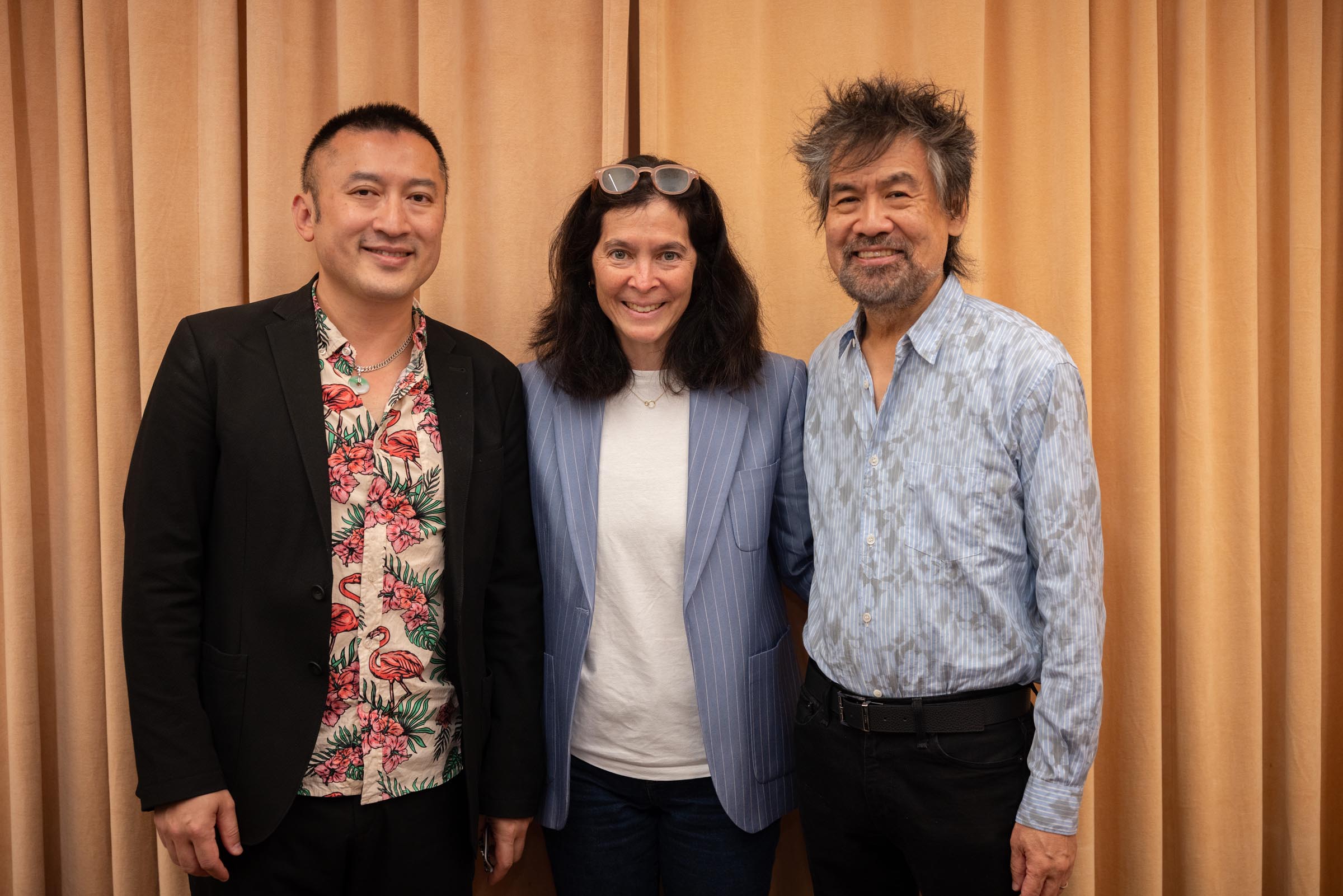 Composer Huang Ruo, Director Diane Paulus, and Librettist David Henry Hwang, at the first day of rehearsals in October 2025. Photo credit: Matthew Washburn
Some of this may sound familiar. Much like Dream of the Red Chamber, which San Francisco Opera brought to the stage first in 2016 and again in 2022 (with a pioneering tour of China in-between), The Monkey King has its roots in a classic novel beloved by billions of Chinese readers over centuries, yet little read in the rest of the world. But mentioning Red Chamber, a domestic drama about a highly literate Chinese family, in the same breath as Journey to the West, an epic adventure freely mixing spiritual allegory with fantasy and martial arts, is like comparing a book club to a circus.
A key difference lies in a single character: a humanoid monkey, arguably the most fallible figure in Asian literature, who freely leapt beyond the novel. Where many Chinese audiences have encountered the Monkey King’s exploits through traditional opera and film adaptations, many Western viewers today have also discovered the character through the Disney+ series American Born Chinese and the role-playing video game Black Myth: Wukong.
Bringing the Monkey King’s origin story to the stage gains from having several perspectives, and the opera’s creative team came to the tale from notably different directions. In their previous operatic collaborations, composer Huang Ruo (born in China in 1976) and librettist David Henry Hwang (born in Los Angeles in 1957) have honed their differences in age and background into a thoughtful examination of Chinese culture and its interaction with the West. Director Diane Paulus, born in New York to a Japanese mother and an American father, has fashioned an illustrious theatre career from her early multitiered training in classical music and dance, with a professional track record of finding new ways to tell established stories. Their Monkey King may come from ancient China, but he offers lessons for audiences today.
You all came from Asian households—in Diane’s case, a half-Asian household—so what was your introduction to the Monkey King and what does he mean to you?
David Henry Hwang: I was born in Los Angeles, and we didn’t have a lot of Chinese influences in my home because our parents really wanted us to assimilate. I didn’t discover Journey to the West until I was in my 20s, when I found the early translation by Anthony Yu. Later, I was given a set of graphic novels, which was my real introduction. I find it interesting that the Monkey King is revered by so many people, even Mao Zedong. Monkey is a revolutionary figure, which goes against this notion of Chinese people being a collective and not standing out as individuals. I think that’s one reason Monkey is so beloved not just in China but throughout Asia. He represents a totally different side of the Chinese character.
Huang Ruo: The first thing that really stuck in my mind was the hour-long cartoon by the Shanghai Animation Film Studio from the 1960s, which is based on the first chapters of the novel. I saw it several times when I was 6 or 7. We didn’t have access to much animation growing up, so as a kid what really struck me was his playfulness. Also, his contradictions—both his hate and love—are so clearly defined. He makes mistakes, but he means well and gains knowledge. This to me is very Chinese. In fact, there’s a little bit of Monkey in all of us!
Diane Paulus: Growing up, I was wasn’t aware of the Monkey King as a cultural figure. Huang Ruo introduced me. He told me that his kids dressed up for Halloween as Spider-Man and the Disney Princess from Frozen, and he wished they could know more Chinese figures from popular culture. That really stuck with me, his urge to bring the Monkey King to a modern audience. There are so many versions, but he sent me to the 1960s animation. So I watched this amazing character fly on clouds, blow on a hair, and become a hundred versions of himself, thinking as a director, “This is impossible to put on stage.” But I do like a challenge.
The novel’s history is rooted in an actual 16-year journey of a Tang-dynasty monk named Xuanzang who wrote about his travels. A millennium later, that austere spiritual experience had morphed into a sprawling martial arts fantasy (the most famous version having 100 chapters) focusing on the monk’s sidekicks. How difficult was this to distill into two and a half hours?
DHH: I already had experience with San Francisco Opera adapting Dream of the Red Chamber into two acts, and that book is much longer than Journey to the West. When Huang Ruo first approached me, however, I complained that I didn’t know how to adapt this story. The novel begins with a big chunk, “Monkey Creates Havoc in Heaven,” which is pretty self-contained but doesn’t end well for Monkey. Then the rest of the book is like network television in the old days, with episodes in no obvious order. There’s probably a reason for the sequence of the chapters, but a casual reader could be forgiven for thinking the novel just bounces from incident to incident. Fortunately, Huang Ruo had a very spiritual, philosophical notion for how to tell that opening section and end it in an emotionally satisfying way.
HR: That first segment has it all: drama, happiness, sadness, even revenge. It’s full of operatic gestures, and we can convey the sense of spiritual transformation in musical and theatrical terms. Though it mixes in some Taoism and Confucianism, the novel is really about the teachings of Buddha. The historical Xuanzang translated the Heart Sutra and the Diamond Sutra, so our opera has Guanyin, the Goddess of Mercy, chanting the Diamond Sutra to Monkey. Of course, he doesn’t listen—not until the end, after he’s captured and trapped under the Mountain of Five Elements. We spent hours trying to figure out how to end the opera. In the original story, Monkey is released by Guanyin basically in a hostage exchange: He gets out only after promising to travel with the Monk on a pilgrimage to bring the sutras to China from India. But that’s not a satisfying resolution for an opera.
Note: This discussion originated as part of the Works & Process series at the Solomon R. Guggenheim Museum in New York on March 9, 2025. Monkey King discussion at the Guggenheim Museum's Works in Process, featuring moderator Ken Smith (left) with Diane Paulus, Huang Ruo, and David Herny Hwang, March 9, 2025. Photo Credit: Elyse Mertz
DHH: It’s certainly not a happy ending for Monkey. We should also probably mention that this opening section tells how this incredibly powerful creature Sun Wukong—the Monkey King— feels he deserves a position in Heaven, but the Jade Emperor and his court don’t take him seriously because he’s undisciplined and, well, a monkey. So he raises a banner declaring himself “The Great Sage, Equal to Heaven,” which really pisses off the Jade Emperor and sets off a big war. They eventually capture Monkey and try to kill him, but they can’t. So he smashes up the joint and can only be stopped by Buddha himself. In our version, the Jade Emperor is pretty corrupt, and Heaven has become a place where everyone protects themselves and their own status. It’s fascinating that figures like Confucius and Lao Tzu appear in the original novel, but they’re kind of the bad guys.
DP: I love how corrupt Heaven is in this story, with everyone so materialistic and power hungry. Getting back to the Five-Element Mountain, when the Monkey King thinks he deserves to be King of Heaven, Master Subhuti (or Buddha) tells him that if he can jump out of his hand into the Land of Bliss he can earn the title. So he jumps, thinking he’s in the Land of Bliss but then realizes that the Five-Element Mountain is actually Buddha’s hand. The fingers close around him, and he’s trapped for 500 years. He has to learn his lesson. All this happens at the beginning of the opera, and from there the rest is really a flashback.
Chinese novels usually alternate between prose and verse, but the poetry works in different ways. In The Three Kingdoms (another of the great Chinese novels), it’s like a Greek chorus, giving you the big picture. Dream of the Red Chamber is exactly the opposite, with poetry revealing the inner thoughts of the characters (several are the poets themselves). But Journey to the West alternates very prosaic writing with elevated texts saying essentially the same thing, but often the poetic version drives the story forward. Did that duality work for opera, which alternates between recitatives and arias, or did you have to find contrasts somewhere else?
HR: Basically, the opera is framed by Monkey’s imprisonment and the singing of sutras, then we tell his story in flashback, starting with his birth. At the end of the opera, Guanyin and the Bodhisattva chorus chant the Diamond Sutra to teach Monkey to let go of all attachments and make room in his heart for compassion. Through this transformation, he is able to release himself from his confinement, which becomes his happy ending.
DHH: Throughout the opera, Guanyin watches over Monkey, trying to support and guide him in his growth. We’ve interspersed our story with the actual text of the Diamond Sutra, which is the only part of the opera in Chinese. The rest of the libretto is in English because, well, it was written by me.
So how does all this finally get to the stage?
DP: We have an amazing visual design by Basil Twist and gorgeous costumes by Anita Yavich, who has a genius for taking inspiration from ancient sources like Peking opera and adding a personal twist. Huang Ruo can better explain some of the ingenious things she did with Chinese characters.
HR: I still remember Anita was excited about using a
3-D printer! She started with the Chinese character “hou” (猴), meaning Monkey. She was also inspired by graffiti art, so she played with that ideograph, sometimes turning it in reverse, to come up with a beautiful image. Personally, because I also grew up watching Transformers, it also looks to me like the mask of a Transformer. This became the inspiration for the Monkey King’s costume, which also incorporates the headdress from traditional Chinese opera.
DP: The main problem is to figure out how to tell the story, so easily presented in animation, in a theatrical way onstage. Basil is not only a set designer but also a puppet designer, so when the Monkey King learns how to fly, how to multiply himself, how to spin in the air with martial arts, we have the options of a singer Monkey King, a dancer Monkey King, and a puppet Monkey King.
HR: In purely practical terms, it’s very hard to find a singer at a high operatic level who also practices kung fu! Once we establish Monkey as a three-in-one being, we have Monkey doing a flip or flying in the sky done through puppetry. When Monkey is fighting the god Erlang, we utilize two dancers. And of course, when Monkey sings, we use our singer. This is actually a great Asian tradition you sometimes see in Noh as well, where the person singing is not the one moving.
DP: We have an entire scene underwater, which was both challenging and delightful to conceive. Basil often works with silk and fabrics—his signature piece Symphonie Fantastique is mostly fabric floating in water—so when he first asked me, “What are you thinking?” I immediately mentioned silk: What if the visuals are all about silk, and the silk keeps changing? It’s a profound challenge to have a story about action that really operates on a spiritual level, and silk for me embodies the opera’s theme of impermanence. Silk makes shapes that completely disappear. The opera quotes the Diamond Sutra: You have to let go of self, accept the impermanence of life. There’s something about the use of fabrics that makes form meet content. We spent five days workshopping various fabrics, along with prototypes of puppets.
Considering that this story comes from a novel called Journey to the West, this opera never gets around to the actual journey. The Monkey King is just one big prologue, set partly underwater with lots of corrupt gods running around. It sounds a bit like another operatic epic we all know.
DP: Huang Ruo says this is the beginning of his Ring cycle.
Are you thinking about further commissions already? Where will the story go in future chapters?
HR: Well, let’s just say, the store is open, and we’re looking for buyers.
Critic and journalist Ken Smith (司馬勤) has covered music on five continents for a wide range of print, broadcast, and internet media. Winner of the ASCAP/Deems Taylor Award and the 2020 SOPA Award for arts and culture reporting, he is the author of Fate, Luck, Chance … the Making of “The Bonesetter’s Daughter” Opera.