

A Rigoletto for Today:
Amartuvshin Enkhbat Discusses his Portrayal of Verdi’s Jester
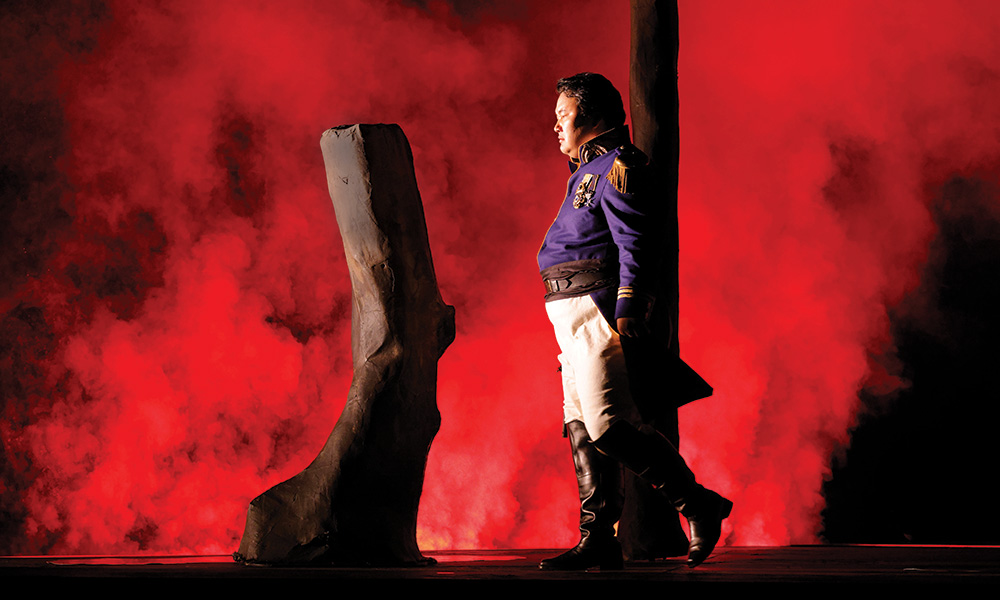
From the moment a DVD from the Verona Arena introduced the young Amartuvshin Enkhbat to Rigoletto, he longed to sing the title role. That desire grew even stronger when, as a university student in his native Mongolia, he had a voice teacher who assigned him “Cortigiani, vil razza dannata,” Rigoletto’s formidable Act II aria.
Having first sung the complete role at the astonishingly early age of 25, Enkhbat is now established worldwide as one of his generation’s premier interpreters of Rigoletto. When San Francisco Opera’s current production concludes, he will have sung the role more than 120 times.
Singing Rigoletto takes enormous vocal stamina, given that it’s unquestionably “one of the most technically challenging roles for baritones,” says Enkhbat. “I can usually sing a Rigoletto performance without getting too fatigued, and I believe this is because I started singing this role when I was very young and full of energy.” The traditions embodied by important Rigolettos of the past—especially the great Italian baritones—are not lost on Enkhbat: “When I first worked on the role, I was listening to Ettore Bastianini. His singing was just so mesmerizing, and I couldn’t not listen to it over and over! And of course, where do I start with the legendary Leo Nucci? I’ve learned a lot from him, just by being in his presence.” The singer also cites his good fortune in being directed in this opera by another celebrated Rigoletto: “the amazing Rolando Panerai.”
Enkhbat continuously studies the singing of his greatest predecessors (“One reason I think they were great is because they were singing in a healthy way”). He refuses to force his voice to make his singing expressive: “My singing is my singing, and if I must alter it to ‘fit’ the role better, then maybe that role isn’t for me.”
Like all outstanding Verdi baritones, Enkhbat relishes the composer’s many thrilling possibilities for exciting top notes, although some of the expected ones for Rigoletto are interpolations not written by Verdi (nonetheless, “audiences come to performances to hear those notes”). Depending on his conductor’s wishes, Enkhbat may choose to include various optional high notes while adhering elsewhere to the printed score. For a production at La Scala, “the conductor asked the cast to sing their parts as written, but they largely ignored the request. I followed my colleagues, and that led to some disagreements!”
In any Rigoletto production, the dramatic side of the title role is a challenge, given that the character certainly has a nasty side. Still, there is tremendous humanity in Rigoletto: “Yes, we do feel sorry for him in almost every act,” Enkhbat asserts. On the other hand, “there is a saying in Mongolian that I think kind of sums up Rigoletto, and it’s hard to translate it into English, but it’s close to the saying, ‘You have made your bed, now lie in it.’”
Enkhbat structures his characterization of Rigoletto with great care and sensitivity. For example, “the entire first act is like behind-the-scenes court life, and I try to show how Rigoletto must act to survive in such chaos. I believe being the court jester is probably the only way for someone like Rigoletto to exist in that world, and he’s terrified of the thought of his pure, innocent daughter getting dragged into this horrific scene.”
Looking at Rigoletto’s conversation with the assassin Sparafucile, Enkhbat is intrigued by the eeriness of the music, created in no small part by the mere fact of two low-voiced men singing together. Of course, Enkhbat quips, “murder for hire will never be cheerful, I’m guessing!” This scene reveals a previously unseen side of Rigoletto, but with the monologue that follows, “Rigoletto shows his true colors—no mask, no pretending—because he’s alone. Here he shows his hatred, his disgust, and his fear regarding the court life.”
There’s another reason why Enkhbat connects so vividly—and, in the end, so poignantly—with this character: “Rigoletto is a father of a young girl, and I am nearing that age where I could have a daughter of Gilda’s age.” As a singer whose repertoire throughout his career has included so many characters much older than himself, Enkhbat seems grateful that most contemporary productions dispense with the longstanding tradition of depicting Rigoletto as an old man: “I have the chance to turn him into a middle-aged man, which is a lot closer to my actual age!”