

Jose Gonzalez Granero. Principal Clarinet
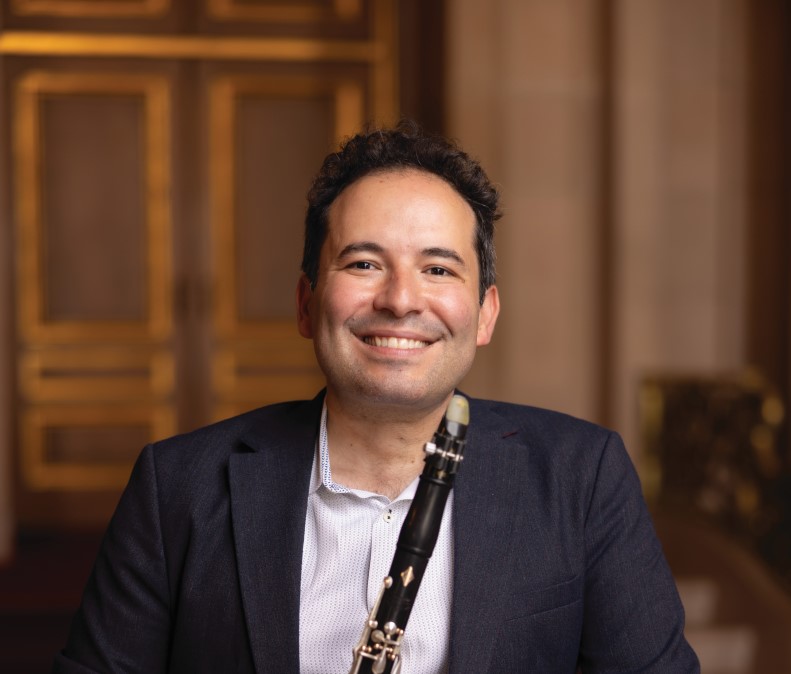
Granero received his B.A. from the Granada Superior Conservatory in Spain and the G. Verdi Conservatory in Italy. In 2007, he moved to Los Angeles to attend the Colburn School of Music and study with renowned clarinet teacher Yehuda Gilad, who encouraged him to “sing through the clarinet.”
“My goal and passion was always classical music since the beginning,” says Granero. “My first opera was Il Trovatore. I was so lucky to get to attend it in Busseto, the birthplace of Verdi.” But it is Mozart he leans into with awe. Mozart’s first operatic use of the clarinet was in Idomeneo.
Granero marvels at Mozart’s intuitive understanding of the clarinet’s potential: “It still amazes me because Mozart used woodwinds in a way that lets it come out in the orchestra. He let the clarinet sing in the highest range of the woodwinds. That color with clarinet, bassoon, and horn is just the perfect combination.” Although the clarinet appears infrequently in Idomeneo, its presence is purposeful, deepening the woodwind textures in moments of pathos, such as during Ilia’s sorrowful arias, and adding richness to the storm scenes in Act III.
One of the most surprising difficulties for the clarinet in Idomeneo isn’t the playing—it’s waiting to play. “In the final act, I might have 20 minutes of silence before my next entrance,” Granero says. “The clarinet cools down; the reed dries out; and if I’m not careful, my first note will be flat. So I have to keep warming it and checking the pads for condensation. I wipe it with cigarette papers!”
If Idomeneo is where the clarinet found its operatic voice, it is Puccini’s La Bohème where it found its heart. The clarinet flows through Bohème’s restless rhythms, adapting to the singers’ feelings as it stretches and contracts alongside them. Granero reflects on Rodolfo’s aria “Che gelida manina,” where the clarinet is a heartbeat: delicate, invisible, but pulsating. “[The aria] is my favorite. What Pavarotti did … when he held the high C note for a long time, it’s amazing. It gives me chills.”
The emotional volatility in Idomeneo requires constant dialogue with Maestro Eun Sun Kim, whose precision fosters an appreciated clarity from the orchestra. “She always is making a connection to the stage, the orchestra, or the chorus. And she’s very, very good at that,” says Granero. “She communicates with her eyes, her baton, her left hand.”
The San Francisco Opera Orchestra woodwind section is a close-knit group. Granero shares his appreciation for the camaraderie with principal bassoonist and neighbor in the pit Rufus Olivier. “We have perfect communication. We can anticipate what the other is going to do. We follow each other. We are friends, too,” Granero continues. “That’s what makes our Orchestra special. We have a very good relationship with each other, no drama.”
Granero, who celebrates his 15th year with the Company this summer, believes the magic of opera lies in its collective spirit. “Every night is different,” he says. “The singer may take a breath differently; the conductor may reshape a phrase. Our job is to listen, be flexible, and adjust to the composer’s vision.” It is a reminder that for Granero, music lives in the spaces between notes, breaths, and shared intention.