

The Journey of Sister Helen Prejean
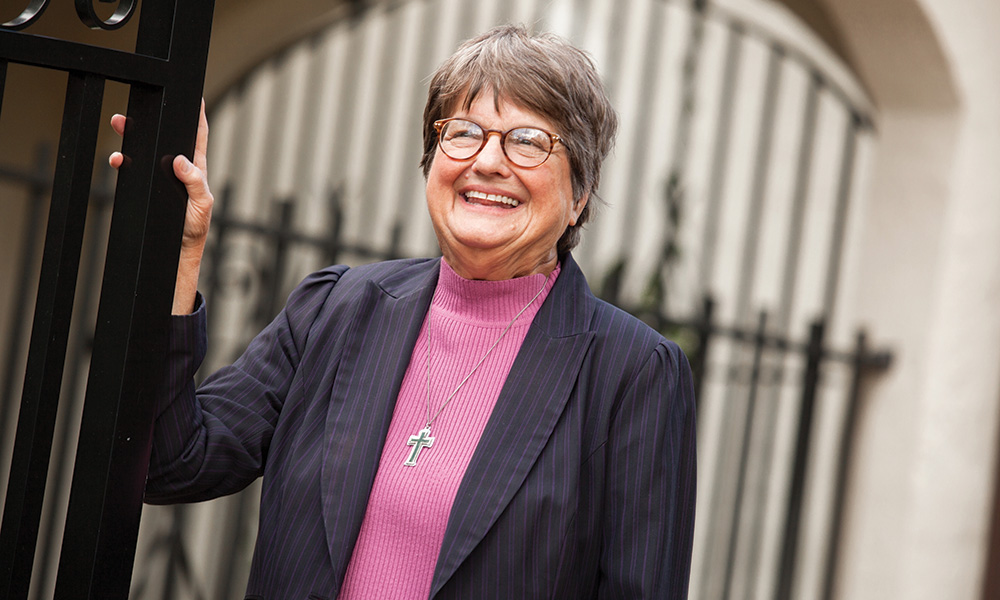
Sister Helen Prejean credits “sneaky Jesus” for the awakening that sparked her lifelong ministry: to serve as a spiritual advisor to individuals on death row, counsel the families of victims and the incarcerated, and to passionately campaign to abolish the death penalty. What began in 1982 as a correspondence with Patrick Sonnier, who had been sentenced to death for the murder of two teenagers, led to her witnessing his execution two years later. This journey is chronicled in the New York Times best-seller, Dead Man Walking: An Eyewitness Account of the Death Penalty in the United States, bringing this “secret” process firmly into public consciousness—inspiring not only the Academy Award-winning film starring Susan Sarandon and Sean Penn (1995) and stage adaptation (2003), but also the groundbreaking opera (2000).
Speaking from her home office in New Orleans, the tireless advocate, now 86 years old, reflects on the powerful legacy of her memoir, the state of the death penalty in the United States, and the nature of heaviness and hope—and how social change only happens when we take collective action to catch the wave.
With adaptations in film, stage, and opera—and soon, a graphic edition—it’s incredible to see the enduring force of your memoir, 32 years after its publication.
Tim [Robbins, who directed the film] kept saying, “The nun is in over her head.” I didn’t know anything about the criminal justice system, I waited too long to reach out to the victims—I didn’t know what to do with them, they were in such pain. I got thrown into this, made some mistakes along the way, but found my way. That’s why I love the aria [“This journey” from Act I]. It’s my journey, and the audience is coming with me.
The sobering part of this for me is I’ve accompanied eight human beings that have been [on death row]; they were killed in front of my eyes, and that keeps me focused and sober. I never completely lose myself: I’ve been through the heart of the real thing. We’ve executed more than 1,600 people. We’ve gassed them and shot them and lethally injected and electrocuted them, and nobody sees it. It’s the few witnesses behind prison walls. And there’s no doubt there’s a connection between transforming public consciousness and conscience. and being able to repeal [the death penalty].
Tell me about working with Jake Heggie and Terrence McNally.
Right away I knew I could trust Jake because he had such a heart. I loved it that Terrence has the murder as the prologue, and everybody sees the two kids being killed. It saves moral energy from people going, “Did he do it or not?” You’ve got to bring the people on the whole journey from the horror of the crime, acknowledging his guilt, and seeing that he’s not remorseful.
There was a special moment when Jake called me and said, “Helen, I think I have the heart of the opera.” And it was the [Act II] sextet where the victim’s family is singing, and the mother of Joseph De Rocher is singing, and he’s plinking it on the piano and trying to sing it for me so I can get a sense of it. In the scene, I’m in the middle going from one to the other, and what am I saying? I’m sorry. I’m sorry.
And I was sorry because I had done it very badly. Terrence brought out the mother of Joseph De Rocher and her own suffering—Flicka [Frederica von Stade] performed that role at the premiere. And it takes me back to the real pain, like the mothers who have a son who’s done a terrible crime.
What’s the current state of the death penalty abolition movement?
The system’s just so corrupted; what happens to human beings who don’t have power and means to get a high-powered lawyer? That’s why you never see rich people go because they get a high-powered attorney and the district attorney can think 50, 100 times before they take them on and try to go after the death penalty.
It’s interesting what’s going on in California, because California, by and large, is a progressive state, and Gavin Newsom has shut down the death penalty. People need to get behind the initiative to repeal the daggone thing. There have been these shifts; now, state after state after state is shutting it down. Where is it happening still? In the ex-slave states, pockets of death that are going on are Alabama, Louisiana … It’s very much a legacy of slavery to have people whose bodies you control, whose lives you control, that you can even kill them. We’re in the last vestiges of this thing, kind of like a war is ending, but if you get killed on the second day before the armistice, you’re still dead.
I so admire your energy and optimism. Does the burden ever feel heavy to you? How do you recharge?
I almost always begin the day heavy like, Oh, what do I need to do? And then the calls come. Sometimes it’s a mother who has that child on death row and he’s innocent. “What can I do? How can I get a lawyer?” It’s overwhelming; a lot of times, I can’t do anything. And then it’s this thing of, how are we going to get to the American people?
I don’t know if I’d use the word optimism for me, but I do use the word hope. And what I’ve discovered is when you’re doing something, when you’re engaged in the current, then the hope flows through you. But if you’re standing on the side just watching it … That’s true, I think, for what’s going on in our country now: people are just standing on the bank saying, “What’s happening to immigrants, isn’t this horrible?” And not being engaged. So that’s the magic of what we hope for with the opera and the events surrounding it, of connecting the activists with art.
[Referring to a painting of an ocean wave on the interviewer’s wall] I love that motion of the water. I didn’t do any serious surfing, it was just a little tummy board. I describe it in my book, A River of Fire, that even in the modified form like that if you go ahead of the wave, you end too quickly. If you miss the momentum, it leaves you behind. But if you catch it, it’s going to take you roaring all the way into the beach. I’ve experienced that a couple of times. So to me, it’s to get on the wave.
To mark San Francisco Opera’s 25th anniversary of Dead Man Walking, Sister Helen Prejean will be featured in free public programs including Faith, Law, and the Death Penalty on September 10 at the Sydney Goldstein Theater (presented with Ministry Against the Death Penalty and the San Francisco Interfaith Council) and An Afternoon with Sister Helen Prejean on September 12 at the San Francisco Public Library’s Koret Auditorium. For more event information, please visit https://www.sfopera.com/dmw-community. To learn more about the new graphic edition of Dead Man Walking, please visit sisterhelen.org/books/.
Filmmaker Elena Park earned her second Emmy directing nomination for Eun Sun Kim: A Journey Into Lohengrin, the acclaimed San Francisco Opera/Lumahai Productions documentary. This fall, she continues as Executive Producer of both the Met’s Saturday radio broadcasts and The Cleveland Orchestra’s In Focus programs, as well as Curator of NationalSawdust+.