

Finding Grace in the Dark: The Transformative Beauty of Dead Man Walking’s Music
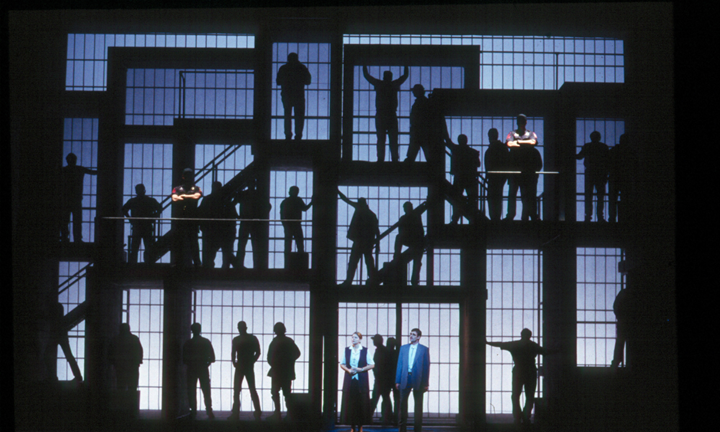
Jake Heggie is well known for composing music that resonates with both trained ears and the human heart. In Dead Man Walking, he constructs a soundscape that is distinctly American. It combines spirituals, jazz-inflected harmonies, and traditional arias with a modern orchestral palette. Heggie’s gift lies in his ability to evoke emotional clarity out of complex situations. The music allows us to feel compassion through melody, and to understand characters through the ache and swell of the music beneath them.
“When Jake [Heggie] and Terrence [McNally] created the opera, I saw new dimensions of the story I hadn’t considered before.” —Sister Helen Prejean.
Photos: Ken Friedman
The premise of Dead Man Walking is about a nun who agrees to serve as the spiritual advisor to Joseph De Rocher, a man convicted of a heinous crime. As she struggles to reconcile the humanity of a man condemned, the opera explores through music impossible questions of mortality and redemption. There are moments of haunting quiet, distinguished by a cappella spirituals, fragments of hymn-like themes, and sections where silence itself seems to carry weight. But there are also moments of overwhelming beauty, including the final duet in which De Rocher, on the brink of execution, at last confesses and asks for forgiveness. The music is so honest and so human that we weep in recognition, not in despair.
“I wept. Because I saw people feeling what I had lived. That’s when I knew we had done something important.” —Sister Helen, on hearing the opera for the first time.
Heggie’s leitmotifs give voice to each character, with Sister Helen’s theme emerging in quiet, hymn-like tones that reflect her moral conviction. The harmonic language is tonal mainly but infused with chromatic tension, especially in dissonant, rhythmically agitated scenes on death row. Heggie’s orchestration is dynamic, shifting from full orchestral surges to intimate ones. The final duet, reduced to just voice and strings, amplifies the raw humanity of the moment.
“The emotional power of Heggie’s score is not that it overwhelms, but that it stays with you.” —Joshua Kosman, Music Critic.
Photos: Ken Friedman
Dead Man Walking is a journey through pain, to healing, to understanding, and an awareness of our shared humanity. Heggie’s music is the guide. If you are either new to opera or an opera lover, this work will remind you why we gather in theaters: to feel together, to confront what is real, and to rise together through story, through song, and in the company of one another.
So come. Be transformed.