

Dead Man Walking at 25:
An Oral History of the Opera’s Creation, World Premiere in San Francisco, and Legacy
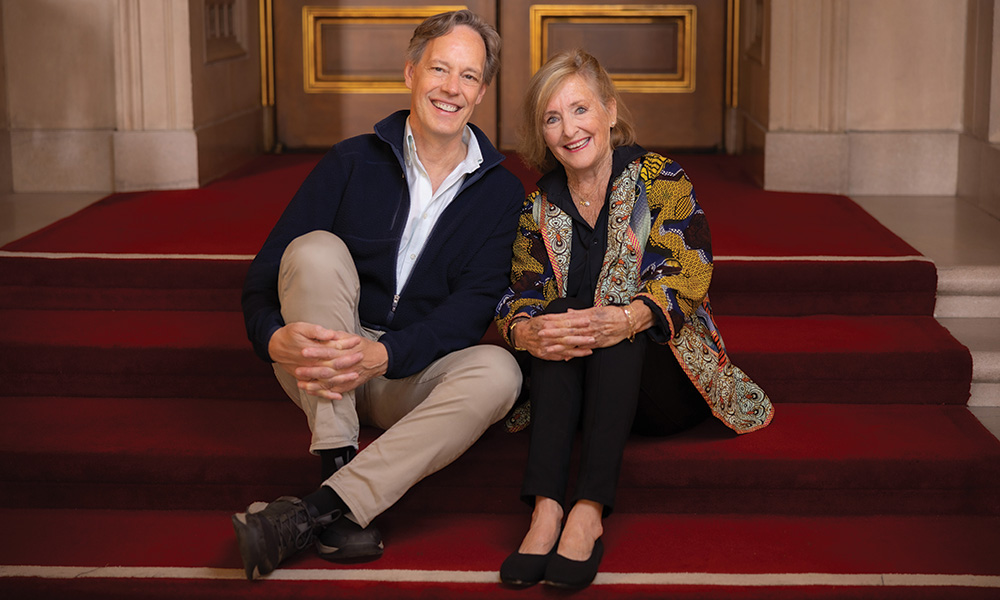
Jake Heggie [JH]: It was because of Lotfi [Mansouri, general director of San Francisco Opera 1988–2001]. I have to give all the credit to him … Lotfi was willing to take chances. He was a true impresario. He had vision, he had passion, and he had imagination about what could happen.
Elena Park [EP]: Flicka [Frederica van Stade], Renée Fleming, Carol Vaness, Jenny Larmore … all of these artists started to request that Jake write for them … “Do you have any songs for me?” People would show up in the PR department, and we’d think they had a question but they’d say, “Just here to talk to Jake!” [Lotfi] was very savvy, and, you know, he was picking up that singers of great stature and talent were recognizing in Jake that there was something extraordinary. [Conductor] Patrick Summers, I think, also recognized the talent. Lotfi observed all of this and seized upon this idea … and followed up really quickly to have a serious conversation about it.
JH: I won a competition through G. Schirmer, and I remember there was a party one night, and Lotfi said to me, “So, Jake, you’re writing all these songs for all these singers. They’re taking them all over the world and performing them, and they seem to love them. Have you ever thought about writing an opera?” I kind of looked at him, “No, not really (laughs). I haven’t because it’s so overwhelming and massive.” He says, “Well, I think you’re a theater composer. I think we should talk.”
The next day, I’m at work and thinking, you know, he was just making party conversation … and my phone rings … So I go over with my pad, ready to write the next press release or whatever. He says, “Put the pad down. Let’s talk about your opera. So, we have a slot in the 2000 season on the mainstage. I want to send you to New York. I’ve been trying to get Terrence McNally to agree to write a libretto, and I want to see if you guys hit it off and if you’d be a good pair.” And I’m looking around, like, who are you talking to? (laughs) He opened this door, and I thought, what have I got to lose? I am jumping through that door!
Lotfi was all in and made contact with Sister Helen. My phone rang one day, I pick it up, and she goes, “This is Sister Helen Prejean. I’d like to speak to Jake Heggie … I understand you want to make an opera out of Dead Man Walking. You know what I said to that, Jake? I said, ‘Of course we’re gonna make an opera out of Dead Man Walking!’ But, Jake, I don’t know boo-scat about opera, so you’re gonna have to educate me … Now, Jake, I know you’re going to have to change things. You’re going to have to rewrite. You’re going to have to add things, take away. You know, it’s for the stage. It’s not the book. The only thing I ask is that it stay a story of redemption.” And I said, “Absolutely, a hundred percent.” And then we were off and running.
Catherine Cook [CC]: It truly was groundbreaking because there weren’t many operas being written about social justice issues, and Sister Helen’s story ... I’d read the book, I’d seen the movie. It was just such a fabulous story. Up until then I don’t think many people were really being that bold to write an opera about capital punishment.
Frederica von Stade [FVS]: I was just lucky and over the moon to be asked to do Dead Man Walking. Jake loves the human voice, so I knew everything would be great, working with him. It’s such a fascinating and vitally important subject to explore, and what better way to explore this subject than through music and through storytelling, so that people come alive and are part of a very important life instance that we all need to know about. It came up that he was going to partner with Terrence McNally, and that I think they had another story in mind first, and then it came around to Dead Man Walking. Jake asked me to sing Sister Helen [Prejean] at first. And I just felt I was senior enough at that point that there were just too many wonderful younger singers, and I said, “I really, really with all my heart want to be in it—please let me be in it—but I just don’t think I’m right for Sister Helen.” And there was marvelous Susie Graham, and Jake asked me to take my choice: one of the parents of the kids who were murdered, or the mother of the convict, and I chose that part. Exploring this woman through Jake’s eyes and through Terrence’s eyes was this amazing gift to me. It made me look at my own motherhood in a whole different way and realize how much of your child’s life you can’t predict and can’t control ... and you hate that, and you hate it about yourself that you can’t make the world pure and good for them.
JH: We had the first act done by November of that year, and then we did the second act, and then we had a workshop in August of ’99 and we needed to make some changes, and then I had to orchestrate. So, it happened–boom, boom, boom!
Kip Cranna [KC]: We workshopped it in the summer of 1999, and that was a fascinating process. Quite a few of the singers who were in that workshop would ultimately create the roles that would be premiered the following year. Even with a piano workshop where people are basically learning their roles … it was obvious that this was going to be a piece of some significance.
CC: [I found the music to be] a little bit [hard to learn]. There’s always an unexpected turn here and there. Rhythmically, you might struggle for a little bit, but once you know it, it’s like, Oh! This can’t be written any other way. It makes so much sense how [Jake] sets text, and how he can sort of build an arc of a scene in the drama. He knows the voice, and not all composers have that gift.
Lori Harrison [LH]: [I took] a trip to the Louisiana State Penitentiary in Angola … visiting death row and visiting their execution chamber, of which I took many pictures, including of the real execution table that they used. We recreated it down to the inch, every strap, every piece of metal. John Del Bono was our master welder at the time, so he pretty much built that table.
John Del Bono [JDB]: My biggest recollection of Dead Man Walking was this amazing amount of research that [Prop Master] Lori Harrison had done. She came armed with a portfolio of photos and drawings and measurements of the actual death chamber in Angola, and its lethal injection table. She was absolutely dead set that we were going to prop this show exactly as it needed to be done. Dead Man Walking was when I first realized I was in the arts, and that we were here to put the best we can in front of the audience.
JH: Terrence gave me the greatest gift. That libretto is a work of genius. Being a theater guy, he wanted to establish everything in theater terms, to make sure we’re not trying to put the book on the stage; we’re not trying to put the movie on the stage; this is for the opera house.
That’s why he wanted to stage the crime, so that we see who did it, we see what he did, we know who’s guilty. The purpose of the opera is not to prove whether he’s guilty. We have total clarity. This is very different from the journey that Sister Helen was on. She didn’t know. We see it as the audience. We are witnesses.
KC: It was pretty clear by the second scene that something fairly special was going on. We begin with this brutal murder, and it’s pretty intense. It’s a tough scene to watch. Then–bam!–we’re hit with the really upbeat scene where Sister Helen is teaching her little hymn to the kids in the school that the nuns run, and this turns into almost a Broadway number. It was clear that this was kind of a dramatic masterstroke, to break that tension with something so engaging.
JH: There was such a feeling of support through the whole thing. It was remarkable to feel that love and support from all those singers, from all my colleagues who were marveling that this thing was happening.
Megan Kellogg [MK]: I was in the San Francisco Girls Chorus, level three or four, so more advanced. I remember it feeling like a very intimate experience, performing with such a small group of kids, because we could hear our own voices, you know, onstage and offstage. Running onstage, you couldn’t see the audience because the lights were so bright, but you could feel the vastness of the Opera House. So, it was incredibly exciting.
CC: One thing that I feel the opera does so well is it really helps us see inside of these characters, of what it would be like if your son was accused, and what it would be like if your child was the victim. I get choked up thinking about it right now. I found out that the person that I was playing [Jade Boucher] did not believe in the death penalty … and that really changed the way I played the character, because obviously you’re grieving and you have anger about what’s happened, but she didn’t want Joe to die.
LH: The [execution] machine was designed by Michael Yeargan, and it had little glass syringes that were visible on it ... My notes very clearly show that there are three solutions, and the timing of those injections … that was explained to me when I was there.
This all happens in complete silence. There’s no music. Some critics pointed that out to Jake, asking him if he was unable to write music for this, and he responded that he didn’t think we needed any “death music,” that we’d heard enough already, and so it’s quite a scene unfolding in silence.
I know that in the moments leading up to that silence, there is an exceptionally moving piece of music. I believe it was the Lord’s Prayer that was being sung in many-part harmony. When I first saw that, in the rehearsal hall from afar, in street clothes, and [with] a piano, just going through that the first time, I was crying.
JDB: This is one of my seminal operatic moments: We were told that we were going to do a full run-through … and they wanted “the chair.” I had been warned that myself and [stagehand] Steve O’Reilly were going to be in costume and we were actually going to be the ones manipulating the chair for the show. Now, I’m pure theater technician. I’ve never acted … I was a little nervous about the fact that I had to go out and do that, but it was the table I built and I knew I was the right person to manipulate it. And then it was time for us to go and grab [John Packard as Joseph], and take him to the chair. I grabbed his arm and I was really surprised that he resisted me … And so, instinctively, I grabbed him harder, which surprised me (laughs)! We’re walking him up to the chair, we’re … strapping him in, and he’s trembling, and I’m like, Oh, this is intense. I find myself trembling, also. We get him strapped in, and then we get to the point where Steve and I are supposed to step back, and he [Joseph] sings an aria, then Sister Prejean sings ... I looked up, and everyone … was bawling. I have never experienced anything like that in my life, and it’s still probably the most powerful emotional experience of my opera career. I really didn’t see that coming, and I was blown away. It changed my whole perspective of this company, and what we’re doing, and why it’s important.
KC: One of my distinct memories—and there are photographs of this—is that after the prisoner is strapped to this table, with his arms out straight to the sides, he’s lifted upright, sort of like he’s on a cross.
LH: It is actually done that way. That table did move into exactly that position. They roll it in front of a big plate glass window. The other side of the plate glass window are chairs. The family of the victim is invited to sit on that side. There’s a curtain that they open up and it’s mic-ed, and he’s allowed to give his final words … The family can actually witness that execution and he has a chance to make whatever amends he can at that point.
The opera company got a letter from a very angry patron, who felt that they were turning this criminal into a Christ-like figure by upping the table and having him hanging there with his arms extended. I had to … carefully craft a response. I talked about how I went to the penitentiary and took photographs and measurements, and that that was exactly the table, and that this was exactly what they did.
KC: There’s always a tremendous excitement about opening nights of a new piece … It’s always unpredictable and a bit of a guessing game of what’s going to happen.
JH: The audience is the last character to show up, and you don’t know what you have until then … You just don’t know until it’s completely on its feet, it’s staged, costumed, the orchestra is there, and it’s opening night. There’s people there with all kinds of differing opinions about whether they think it’s actually going to work or not, but there was great curiosity and energy about it. And I knew that it was very powerful and that it was very effective. I had no idea what the real response would be, because, of course, I was unproven as an opera composer.
Sister Helen came up to me and said, “Jake, this is a big night. Your job tonight is just to stay present in the moment. Don’t think about what led up. Don’t think about what’s gonna happen next. Stay in the moment.” And I did.
CC: I knew it was going to be a huge success. There were protestors outside of the Opera House on both sides [of the death penalty issue]. It got people talking, and it was really a huge moment, I feel, in opera history. I don’t say that lightly. Things changed after Dead Man Walking, and people started taking more risks ... It changed people’s lives. It changed my life.
JH: Sister Helen was so happy and so grateful. She said, “Tonight, 3,000 people witnessed an execution … this thing that happens in the middle of the night, that they try to keep secret and out of everyone’s eyes. You saw a human being. You didn’t see an archetype; you saw a human being be executed, one that said, ‘I love you,’ and those were his last words.”
FVS: [The opera] was very controversial at the time, and that needs to be said. But I thought it was going to be an enormous success, a controversial success, maybe, but a success, because of the truth of it. It’s a true story, and it’s a story that you don’t usually confront in opera—or you don’t think you do, but where do you go for murder and intrigue and sorrow and grief and jumping off turrets, but the opera house? And at first, you know, I thought, well, starting with a murder and ending with an execution isn’t a great recipe for a great evening in the opera (laughs), but that’s not the only mission of opera. The opera is to tell a story, and this is a story, a human love story between Sister Helen and Joe, and Mrs. De Rocher and Sister Helen, and the children and the parents. It’s an exploration that has a very wide ring around it. Like you throw a rock in the lake and it makes a very satisfying plop, and then all the rings go out … Every time I’ve done this piece that has been my experience. The ring encompasses a lot of people.
JH: By the end, when there’s that silence of the execution and the pause after, and then Sister Helen steps forward and sings a capella [unaccompanied] the tune that she sang at the beginning—the hymn—you could feel in the house ... an active, fraught silence. What could be more powerful than an activated stillness and silence? But it went on so long, and ... I was a wreck. Then when those lights went off, that place just exploded, and I knew it was really special.
MK: I was a freshman in high school, and if I hadn’t done Dead Man Walking I honestly don’t know where I would be, because it ignited a passion for opera that had not been there.
KC: Shortly after our premiere, a consortium was formed of seven different opera companies, with a new production in mind that was directed by Leonard Foglia, and that’s the production that we’re essentially doing this season, with some modifications, here in San Francisco. It’s been done in many, many places now, and I’ve seen quite a few. What’s been fascinating is seeing the variety of artists that have taken on these roles. It was hard not to think of the original performance as sort of definitive, particularly Frederica von Stade as Mrs. De Rocher, the mother of the convict. Her scene where she pleads for her son’s life before the Parole Board is indelibly etched in my mind.
CC: I’m so happy that the opera has been done so much, because it’s one of the best, really, that we have. It has been performed by so many different artists all over the world, and that is a true testament to how amazing this piece is and how it connects with people.