

What Makes a Great Carmen?
By Roger Pines
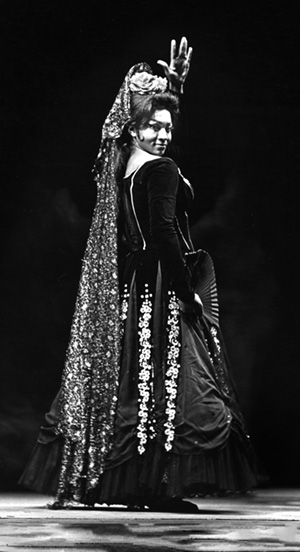 Next year Carmen will be 150 years old—not too shabby for an opera that is still one of the art form’s most popular works. Despite its grand old age, Carmen remains compelling, thanks to composer Georges Bizet’s alluring portrait of the title heroine which remains eternally fresh. This role has had many exceptional interpreters, but—whether due to the performer’s own ideas or those of a director—Carmen is often presented onstage as a clichéd view of what an effortlessly seductive woman can be. Going along with that, we often hear the singer push and force her voice in this music, as if that were how to create drama onstage. So how does the singer give the character appeal that goes beyond the stereotypical “sexy lady,” while also doing full justice to the music?
Prospective artists taking on the role should bear in mind that Carmen was not composed as a grand opéra for the massive voices heard at the venerable Opéra de Paris. Bizet’s masterpiece is an opéra comique which premiered in 1875 at the theater of that name, a smaller venue that made the work more human, more accessible. One can imagine how the premiere sounded by listening to Carmen’s earliest French-language recording, made in 1911. Except for the vocally stolid Don José, everyone (especially soprano Marguerite Merentié’s Carmen) exhibits marvelous lightness of touch and an ability to turn singing into genuine conversation. Listening to other opéras comiques, it’s clear that any composer in this repertoire had that conversational element as a primary goal.
That recording stayed true to the original production by employing spoken dialogue, not the sung recitatives composed by Ernest Guiraud after Bizet’s death. The recitatives helped the opera gain popularity, but choosing to eliminate the spoken word and have every line sung actually compromised much of the opera’s crucial intimacy while imposing a kind of straitjacket on characterization. The dialogue helps to bring listeners closer to who Carmen really is, not only through a distinctive singing voice covering two octaves but also a well-projected speaking voice, inflected with the naturalness of a fine legitimate-theater actress.
Although more frequently assigned to mezzo-sopranos with both a colorful sound in their lower octave and absolute security at the top, Carmen has also been taken on by higher-voiced sopranos and contraltos, whose range extends below that of a mezzo. Whatever her voice type, the singer’s performance should stress the tenets of opéra-comique: first, unfailingly specific, meaningful textual projection; and second, dramatic involvement that never sabotages the music’s innate elegance.
The libretto’s literary source, Prosper Mérimée’s Carmen novella (1845), presents a protagonist for whom one feels nothing. Mercenary, callous, sometimes cruel, she ultimately cares for no one, making José’s attraction to her perplexing, to say the least. In contrast, Bizet’s music makes clear that Carmen must be likeable. If she’s not, there’s no opera (not one to believe in, at any rate). If listeners connect with her, the opera’s dénouement will leave them shattered. Shirley Verrett, a magnificent Carmen in the 1960s and ’70s who challenged her audiences’ notion of the role, once commented that we should ask “Why did this happen?” rather than declare Carmen got what she deserved.
The character’s entrance scene centers on her intoxicating “Habanera.” Here Carmen reveals the nature of love (“a rebellious bird that knows no law”) and her own response to it (“If you don’t love me, I’ll love you; but if you love me, beware”). She should radiate confidence but also insouciance and cool indifference. The singer can draw an audience to her simply by coloring each phrase with specificity. Too many singers growl the lowest phrases, but if Carmen does that, she can instantly lose her appeal.
When the audience encounters her for the second time in Act I, Carmen has just fought and wounded another cigarette-factory worker. Awaiting orders, Don José escorts her to prison which gives Carmen time to tantalize him with the “Seguidilla” (like the “Habanera,” a captivating setting of a popular Spanish dance form). Here Carmen reveals her current sexual availability, since she just kicked her latest lover out the door! A delicious lightness and flexibility here (for example, in the triplets of the phrase “chez mon ami Lillas Pastia”) enable Carmen’s charms to work their magic.
Act II requires tremendously varied expressiveness from Carmen, whether excitingly vigorous or exquisitely intimate. She begins with the “Chanson Bohémienne,” which is concentrated in the middle range of her voice but increases in volume and tempo as the music progresses. Bizet gives it a wonderful refrain (no other composer has made “tra-la-la” sound so enticing), but only the best Carmens can expertly articulate those tricky little groups of sixteenth notes!
A few bars before the bullfighter Escamillo ends his “Toreador Song,” Carmen interjects a single phrase—“L’amour.” Carmen’s friends, Frasquita and Mercédès, have each just sung that word, but Carmen’s voice plunges much lower, inevitably giving the phrase greater sultriness. Listen to how she colors “L’amour”: Is she already attracted to Escamillo? Or does she sing quietly, dreamily, without addressing anyone in particular?
Shortly after Escamillo’s departure, Bizet’s score offers one of the opera’s most exhilarating numbers: the quintet for Carmen, Frasquita, Mercédès, and the smugglers Dancaïre and Remendado. Carmen must adeptly blend her voice with the others, singing in close harmony at lightning-quick speed. The quintet relaxes musically in its middle section, when Carmen announces that she won’t be participating in the guys’ latest smuggling venture. Her charm can again come through, along with irresistible warmth as she confesses, “Je suis amoureuse” (“I’m in love”).
The volatility of Carmen’s feelings for José makes the second half of Act II an emotional rollercoaster. As she dances for him, her wordless melismas (groups of notes sung on one syllable) need maximum sensuality. This is, after all, the man she loves—at least, she does at this particular moment. But when José gets up to leave after hearing the distant bugle call, Carmen’s repeated “Taratata” should sting him with their sarcasm, not cheapened as some Carmens do in trying to make this tense moment comical, even grotesque.
After José’s lovesick aria, Carmen’s response—“Non, tu ne m’aimes pas” (“No, you don’t love me”)—is marked ppp (very soft), but it should still smolder with intensity. Painting a romantic picture of life in the mountains, Carmen begins quietly, but the music soon builds excitingly to that vital phrase, “la liberté”! Carmen is a Roma. For her, liberty ultimately means being able to live by her own rules.
Without freedom Carmen would rather die, and José’s inability to understand that dooms their relationship. In Act III, their opening dialogue—when Carmen suggests that he go back to his mother—concludes:
JOSÉ: If you say that to me again …
CARMEN: You’d kill me, perhaps? I saw several times in the cards that we’d end together.
JOSÉ: You’re the devil, Carmen!
CARMEN: Yes, I’ve told you that already.
Many Carmens are nasty here, almost villainous, which misses the point. She’s tired of José, and she’s simply being honest—she can’t be otherwise.
After her friends’ lighthearted fortunetelling, it’s Carmen’s turn with the cards. Too often you’ll hear her sing “Carreau! Pique!” (“Diamond! Spade!”) without coloring the words. (In the glorious Carmen recording by Leontyne Price, her hushed “Pique!” gives the character just a touch of unexpected apprehensiveness.) Seeing the death card, Carmen needs enough vocal strength and color to rivet the listener as she slowly descends into the lower register. The ensuing “card aria” needs comparatively quiet, straightforward legato (connecting the words with one breath). Many singers over-emotionalize it, but why? For Carmen, when the die is cast, it’s cast. The aria works best when imbued with calm resignation—exactly what Marguerite Merentié achieved in this scene, to memorable effect, back in 1911.
What a contrast in the next number, Carmen’s one moment of delight in Act III: the marvelously buoyant ensemble with chorus, which she leads with Frasquita and Mercédès. “Let us take care of the customs guards,” they sing. When really sparklingly sung, with the three solo voices ideally blended, this music is a joy.
In Act IV, Carmen and Escamillo sing a brief, pre-bullfight love duet. Her response to him communicates a certain foreboding (“May I die if I’ve ever loved anyone as much as I love you”). Although not overtly passionate, the music does give Carmen an opportunity for luscious tone and finely sculpted phrasing in this calm-before-the-storm moment,
The final scene offers powerful drama, but this is still an opéra comique. In other words, the singers should resist imposing on the music a verismo-like delivery that Bizet didn’t intend. At the start Carmen can be cool—not cold, but cool. If she gives too much in the first section beginning “Tu demandes l’impossible!” (“What you’re asking is impossible!”), she has nowhere to build. As the tension mounts, if she forces her middle range for more power, she won’t nail the defiant high A-flat of “Non, je ne te céderai pas” (“No, I won’t give in to you”). José’s anguished “Tu ne m’aimes donc plus?” (“Then you don’t love me anymore?”) doesn’t faze Carmen; she admits that she no longer loves him. Bizet marks her line tranquillement as she is still able to control her feelings. If she sings that phrase as marked, her final, full-voice declaration—that, in the face of death, she will repeat that she loves Escamillo—can make double the impact.
Carmen’s last line is potentially devastating: “Tiens” (“Take it”) she says, pulling off a ring José gave her. Sung on an E that is marked ff (loud), it is the opera’s one moment where ignoring the written note and speaking the word feels appropriate. It is not at all uncommon to hear singers go wildly overboard, suddenly turning Carmen into a caterwauling animal. Doing so constitutes a hideous betrayal of Bizet and his brave, proud heroine. French mezzo-soprano Régine Crespin created a stunning portrayal that showed Carmen need only drop the ring at José’s feet and utter a quiet, almost matter-of-fact “Tiens.” Never was a “less is more” approach more telling onstage.
Roger Pines teaches in the Voice and Opera department of Northwestern University’s Bienen School of Music. A longtime judge of the Metropolitan Opera’s Laffont Competition, he writes frequently on historically important singing for Opera magazine (UK), while also regularly contributing articles to programs of major opera companies and recording labels. He has been a panelist on the Metropolitan Opera’s Opera Quiz broadcasts every season since 2006.