

San Francisco’s Living Legacy: The Pride Circle

Twin Peaks Tavern (Castro & Market)
The first gay bar in the U.S to feature large, outward-facing windows, Twin Peaks Tavern defied societal norms in the 1970s by allowing LGBTQIA+ patrons to be seen rather than hidden behind closed doors. This visibility was a radical act in an era when being openly queer often meant job loss, eviction, or violence, and remains a symbol of coming out in the gay community.
Today, its undressed windows are a metaphor for the ongoing fight for openness and acceptance. Twin Peaks Tavern continues to be a symbol of queer visibility and pride in the heart of the Castro.
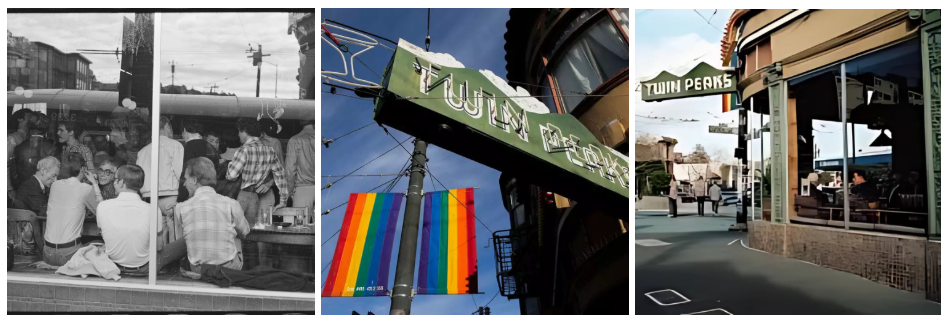 1. Looking inside Twin Peaks (1980s) / Through The Windows 2. Signage 3. The Tavern received San Francisco Designated Landmark status on February 6, 2013 / Through The Windows
Compton's Cafeteria Riot (Taylor & Turk)
Three years before Stonewall, in Greenwich Village, there was the Compton’s Cafeteria Riot in the Tenderloin District. In 1966, transgender women and drag queens fought back against police brutality in this cafeteria. It was one of the first recorded acts of collective queer resistance in U.S. history.
While the original site of Compton’s Cafeteria is gone, its legacy endures through a commemorative plaque, vibrant murals, and a dedicated exhibit in the permanent collection of the Tenderloin Museum. The museum is honored to present the reopening of an interactive play, The Compton Cafeteria Riots, on April 11, 2025, at the museum's newly dedicated theater venue at 835 Larkin Street.
Compton’s Cafeteria Riot remains a pivotal event for the LGBTQ+ community, marking a defining moment in Tenderloin history. permanent exhibition, bringing this crucial story to life in the heart of the neighborhood that continues to honor the riot’s profound impact.
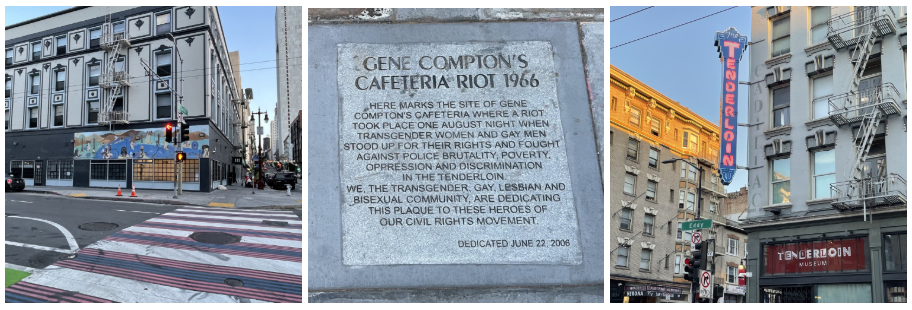
1. The Compton’s Cafeteria building, the site of the August 1966 uprising / JL Odom 2. Historical marker (1966) / Scott Strazzante, The Chronicle 3. Tenderloin Museum / JL Odom
Mona's 440 Club (Broadway & Montgomery)
Opening in 1936, Mona’s 440 Club is considered the first openly lesbian bar in San Francisco. It was a space where women and transgender people could be themselves in a time when being yourself could lead to arrest.
Though Mona’s 440 Club no longer exists, its legacy remains in the ongoing fight for safe spaces for lesbians and nonbinary people. Today, LGBTQIA+ bars continue to struggle with gentrification and economic challenges, making Mona’s story as relevant as ever.
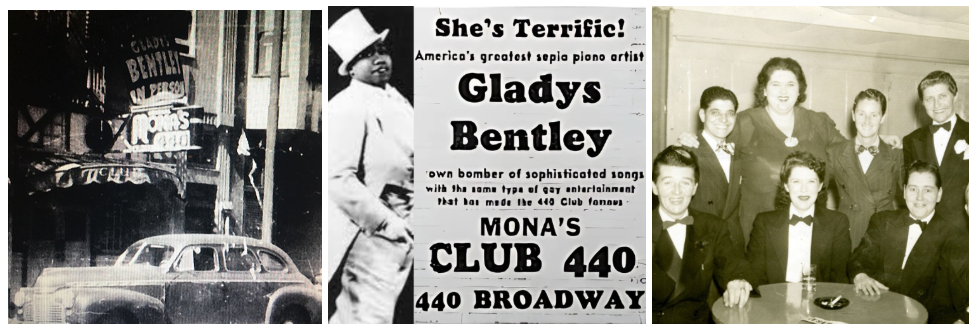
1. Mona’s 440 Club w/ Bentley Marque (1940s) / GLBT Historical Society Archive 2. Gladys Bentley Ad for Mona’s (1940s) / National Park Service Archive 3. Staff and Male impersonator performers at Mona’s 440 Club (1940s) / National Park Service Archive
National AIDS Memorial Grove (Nancy Pelosi Dr & Bowling Green Dr)
The HIV/AIDS epidemic devastated the country and San Francisco in the 1980s and ‘90s, with almost half a million lives lost, many due to government neglect and societal stigma. The National AIDS Memorial Grove was created to ensure that these lives, and the lessons of that time, are never forgotten.
The fight against HIV/AIDS continues, with advances in medicine, but persistent disparities in healthcare access remain. The Grove is not just a place of mourning; it’s a call to action for continued advocacy and education.
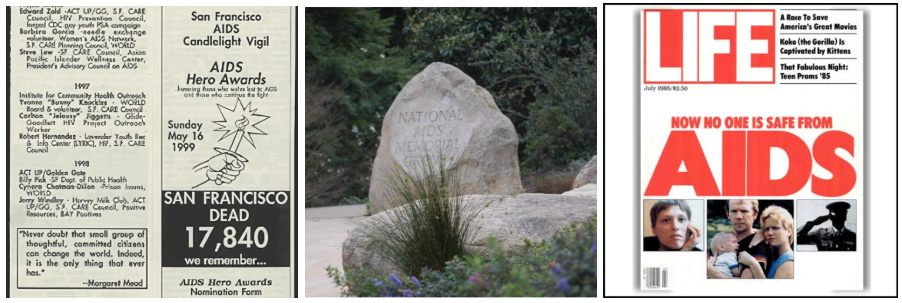 1. “The Year of the Plague” (1984) / AIDS Legal Referral Panel records & GLBT Historical Society Archive 2. National Aids Memorial Grove / National Aids Memorial Archive 3. LIFE Magazine (July 1985) / Life Magazine Archive
War Memorial Opera House (Van Ness & Grove) – Sylvester’s High Note
In 1979, disco icon and gender-nonconforming performer Sylvester recorded his legendary album Live at the Opera House with the San Francisco Symphony at the War Memorial Opera House. His music and flamboyant persona established him a queer trailblazer in an industry that often erased LGBTQIA+ artists.
The War Memorial Opera House, a historically conservative institution, now hosts Pride events and queer performances, showing the evolution of mainstream acceptance. Sylvester’s legacy is a reminder that joy and visibility can be revolutionary.
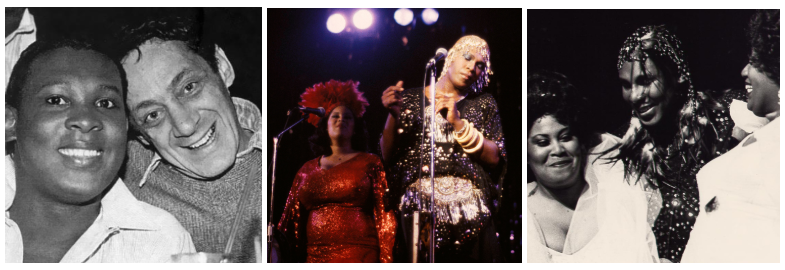
1. Sylvester with Harvey Milk (19780 / Jean Arm 2. Sylvester at the War Memorial Opera House (1979) / Jean Arm 3. Sylvester at the War Memorial Opera House (1979) / Jean Arm
The Past Meets the Present
These landmarks teach us that liberation requires visibility, rebellion, community, advocacy, and joy. The Pride Circle turns those lessons into action through the power of art. By supporting this cause, we contribute to San Francisco Opera’s artistic legacy and affirm the enduring necessity of these transformative values in our cultural fabric.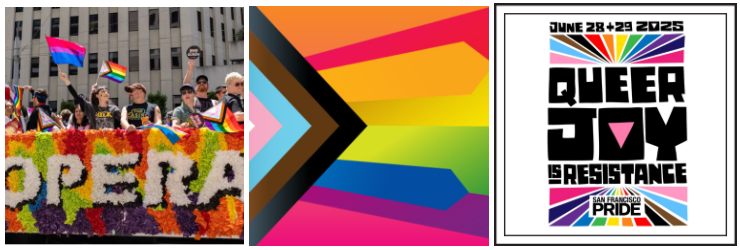
Join the Pride Circle
Your gift supports the Pride Concert and Bay Area LGBTQIA+ organizations while honoring the history that made it possible. Choose a tier tied to these iconic sites and help write the next chapter.