

From Puccini to Pop Culture: The Enduring Legacy of La Bohème
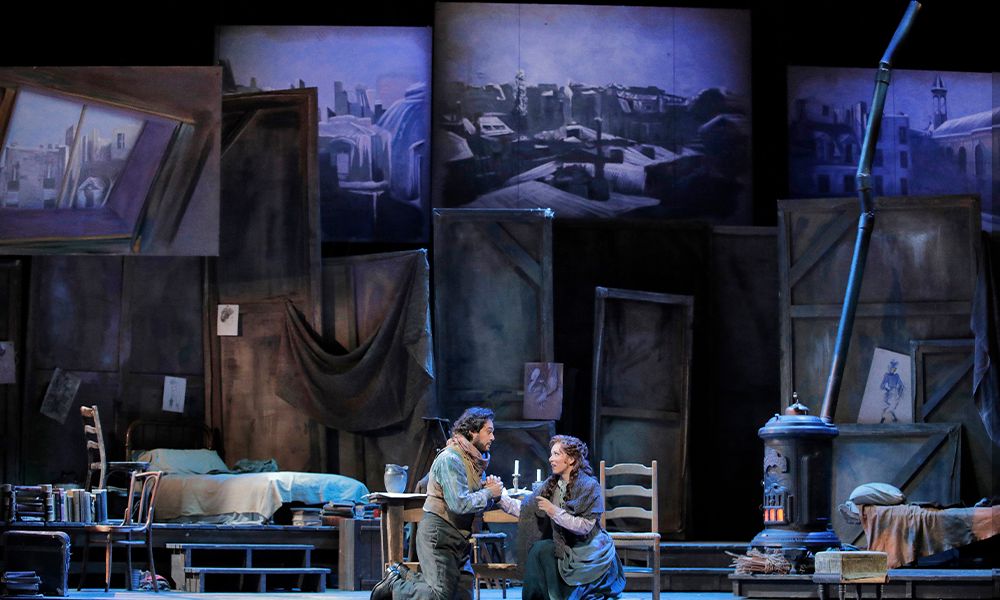
In a world that often feels divided and uncertain, La Bohème reminds us of the enduring power of creativity, the importance of individual expression, and the unbreakable human spirit. This is the world of Puccini's La Bohème, an opera that has continued to captivate audiences for over a century, continuously inspiring artists, filmmakers, and musicians, and remains as relevant today as it was at its premiere.
Adapted from "Scènes de la vie de Bohème," a novel by French writer Henri Murger (1851), and premiering at the Teatro Regio in Turin, Italy (1896), this verismo masterpiece continues to captivate audiences around the world, not only with its lush melodies and poignant love story but also for its profound themes of art and personal freedom. It is a cultural mirror reflecting generational challenges and triumphs in our world today.

1. Scènes de la vie de Bohème by Henri Murger book cover 2. San Francisco Opera’s first program (1923) 3. Program insert of cast (1923)
The mid-to-late 19th century was a world in flux. Europe was undergoing rapid industrialization. Paris in the 1830s, the setting for La Bohème, is a prime example of this transformation. The social landscape swelled with struggling artists and intellectuals. These individuals formed the backbone of the Bohemian movement, a countercultural revolution that celebrated personal freedom.
La Bohème's debut at San Francisco Opera in 1923 set the stage for a world-class Opera Company in the Bay Area. It was a favorite of General Director Gaetano Merola. Between 1943 and 1954, it was performed every season, a testament to both Puccini's masterpiece and the legendary casts that brought it to life. From the luminous Licia Albanese and Bidú Sayão to Jan Peerce and Swedish tenor Jussi Björling, the artists cemented La Bohème as part of San Francisco's cultural DNA. It returns this season under Ramón Tebar's baton, reminding us of its profound relevance.

1. La Bohème cast (1944) / R. Strohmeyer 2. La Bohème cast (1948 ) / R. Strohmeyer 3. La Bohème cast (1949) / Paul G. Tracy
Read more about Bidú Sayão on STREAMING THE FIRST CENTURY, Down the Rabbit Hole.
At its heart, La Bohème is an ode to the bohemian lifestyle—the original Friends—where art, love, and a dedication to community take precedence over material wealth. Each character embodies a facet of self-expression, and their lives echo through history and into today's pop culture. These themes of love, art, and personal freedom are not confined to the opera stage but resonate with all of us, making La Bohème a truly universal work of art.
Rodolfo—the dreamer, the poet, the romantic—chooses art over convention. His iconic aria, “Che gelida manina” (“What a frozen little hand”), is a declaration of artistic identity:
“Chi son? Sono un poeta. Che cosa faccio? Scrivo. E come vivo? Vivo.” (“Who am I? I am a poet. What do I do? I write. And how do I live? I live.”)
Rodolfo exists triumphantly and unapologetically, embodying a spirit that resonates deeply with modern artists.
Jonathan Larson's Rent is a direct descendant of La Bohème, transplanting the story to 1990s New York during the HIV/AIDS crisis. Rodolfo becomes Roger, a struggling musician, while Mimì remains a fragile yet luminous figure. Songs like "La Vie Bohème" celebrate the same themes of authentic living that Puccini immortalized a century earlier.

1. Luciano Pavarotti as Rodolfo in La Bohème at San Francisco Opera (1967) 2. Roger Davis as Roger in RENT: The Movie (2005) / Everett Collection 3. Piotr Beczala as Rodolfo in La Bohème at San Francisco Opera (2008-09) / Terry McCarthy
Mimì—the delicate seamstress—struggles against illness and poverty, yet resiliently finds beauty in life’s simplest moments. In “Mi chiamano Mimì,” (“They call me, Mimi”) she sings:
“Ma quando vien lo sgelo, il primo sole è mio, il primo bacio dell’aprile è mio!” (“But when the thaw comes, the first sunshine is mine, the first kiss of April is mine!”)
Mimì, despite her weakening health, speaks to love through the lens of eternity. The 1987 film Moonstruck pays homage to La Bohème when Loretta (Cher) and Ronny (Nicholas Cage) attend a performance at the Metropolitan Opera. As Mimì sings "Donde lieta uscì" (“Whence he came out gladly”), Loretta, caught in her own whirlwind of love and loss, is moved to tears—proof that Mimì's story remains universally affecting.

1. Alexia Voulgaridou as Mimi in La Bohème at San Francisco Opera (2014-15) / Cory Weaver 2. Cher in Moonstruck (1987) / MGM 3. Dorothy Kirsten as Mimi in La Bohème (1969) / Robert Cahen
Musetta–the fiery and unapologetically bold singer–refuses to be defined by societal norms. In “Quando m'en vo’” (“Musetta's Waltz”), she declares:
“Così l'effluvio del desìo tutta m'aggira, felice mi fa! (“So the scent of desire is all around me / It makes me happy!”)
Her rebellious spirit reverberates through generations of women who refuse to conform.
Baz Luhrmann’s Moulin Rouge! borrows heavily from La Bohème, with Nicole Kidman's Satine embodying Musetta's spirit. A glamorous performer torn between love and ambition, she, like Musetta, seeks independence in a world that wants to control her.

1. Ann Panagulias as Musetta in La Bohème at San Francisco Opera (1993-94) / Cory Weaver 2.Nicole Kidman as Satine in Moulin Rouge! (2001) / @nicolekidman / 3. Anna Netrebko as Musetta in La Bohème at San Francisco Opera (2003-04) / Ken Friedman
Marcello, the passionate painter; Schaunard, the eccentric musician; and Colline, the philosophical thinker–the heart of the bohemian collective, which values art, ideas, and friendship over materialism.
In act 2, the friends join in the square on Christmas Eve. Schaunar haggles over a horn and a pipe while Colline purchases a worn coat and shoves books in all the pockets. Inside the crowded Cafe Momus, the friends gather in good spirits:
MARCELLO: “O bella età d’inganni e d’utopie / Si crede, sepera, e tutto bell appare.” (“Oh, happy age of illusions and Utopias! One believes and hopes and everything seems lovely.”)
RODOLFO: “La più divina della poesie è quella, amico, che c’insegna amare!” (“The most divine poetry, my friend, is that which teaches us to love!”)
San Francisco has long been a city that champions the freedom to live uniquely. Various creative movements have shaped its vibrant culture, from the writers, artists, and musicians who founded the private Bohemian Club on Nob Hill in 1872-present to the Beat poets of North Beach and the counterculture of the 1960s. This rich tapestry reflects the Bay Area's enduring spirit of authenticity, showcasing a legacy of those who dare to live life on their own terms.
A defining moment in this artistic lineage occurred on October 7, 1955, at the Six Gallery. Jack Kerouac captured this significant evening in his book, Dharma Bums, where icons such as Lawrence Ferlinghetti, Gary Snyder, Neal Cassidy, Michael McClure, Peter Orlovsky, Robert LaVigne, and Kenneth Rexroth gathered for the first reading of Allen Ginsberg’s groundbreaking poem, “Howl.” With Lester Young playing in the background, this event symbolized the confluence of voices that would significantly influence American literature and culture, marking the Beat Generation’s emergence and its steadfast commitment to creative expression.
“I followed the whole gang of howling poets to the reading at Gallery Six that night, which was, among other important things, the night of the birth of the San Francisco Poetry Renaissance. Everyone was there. It was a mad night. And I was the one who got things jumping by going around collecting dimes and quarters from the rather stiff audience standing around in the gallery and coming back with three huge gallon jugs of California Burgundy and getting them all piffed so that by eleven o'clock when Alvah Goldbook [Allen Ginsburg] was reading his poem 'Wail' [“Howl”] drunk with arms outspread everybody was yelling 'Go! Go! Go!' (like a jam session) and old Rheinhold Cacoethes [Kenneth Rexroth], the father of the Frisco poetry scene was wiping his tears in gladness.”
La Bohème embodies this spirit–the conviction that art is worth struggling for, that community is vital, and that beauty flickers, even in darkness. In an age when the intrinsic value of art hangs in the balance, Puccini’s masterpiece definitely proclaims art is not a privilege and individualism is not a luxury but indispensable lifelines for the human spirit. Defiant, these characters create, love, and resist, proving once more that art thrives not in solitude but in bold perseverance.

1. Samuel Ramey as Colline, Giacomo Aragall as Rodolfo, Federico Davia as Benoit, Dale Duesing as Schaunard, Brent Ellis as Marcello (1978) in La Bohème at San Francisco Opera / Ron Scherl 2. Neal Cassady, Allen Ginsberg, Robert La Vigne outside Lawrence Ferlinghetti’s City Lights Bookstore, San Francisco (1956) / Allen Ginsberg Corbis 3. Quinn Kelsey as Marcello, Piotr Beczala as Rodolfo, Brian Leerhuber as Schaunard, Oren Gradusas Colline in La Bohème at San Francisco Opera (2008-09) / Terrence McCarthy
This June, La Bohème returns to the War Memorial Opera House in a star-studded production that promises to dazzle audiences with breathtaking voices, period design, and the timeless magic of Puccini's music. This beloved opera revisits our stage in the John Caird production, capturing the passion, heartbreak, and beauty that have made it an enduring classic. The production will also be available via Livestream, allowing opera lovers near and far to experience its grandeur from the comfort of home. Audiences can deepen their appreciation with an insightful pre-opera talk before every performance by the esteemed Robert Hartwell, a master of making classical music come alive for all. And a 90-minute in-person presentation preview by Kip Cranna, Dramaturg (Scholar in Residence) and Emeritus of San Francisco Opera. Whether you are a devoted opera aficionado or new to Puccini's world, this unmissable production of La Bohème reaffirms why the story of artists, love, and freedom resonates across generations.