

Strauss at Home
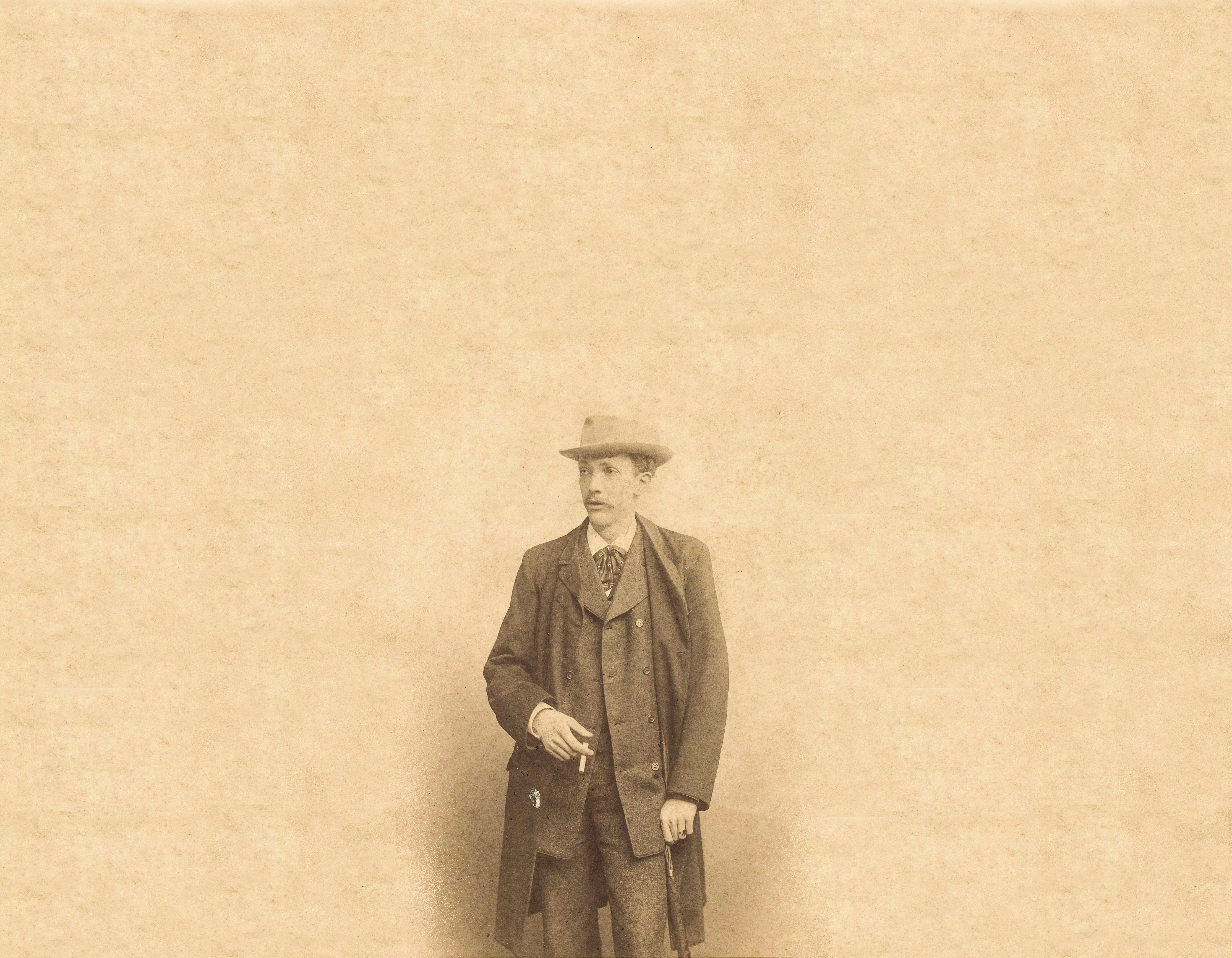
Richard Strauss wrote the works on tonight’s program across a quarter-century—as an audacious 30-year-old composing Till Eulenspiegel in 1894–95, then as a globally celebrated mature composer returning to the intimacy of song with Brentano Lieder in 1918. Between those landmark works came a marriage, a mountain villa, a remarkable artistic partnership, and Der Rosenkavalier, one of opera’s great meditations on love and the passage of time. Follow Strauss through that changing world across these three pages, and witness the faces, spaces, landscapes, and relationships that played into his music.
RICHARD STRAUSS, 1894: THE YOUNG MAN
On the rise. When the portrait on the right was taken in Weimar in June 1894, Strauss was about to turn 30—and his life was changing quickly. His first opera, Guntram, had premiered a month earlier; that September he married its leading soprano, Pauline de Ahna, and returned to his native Munich as second Kapellmeister at the Court Opera. By late that year, another character began occupying his imagination: Till Eulenspiegel, the legendary trickster of German folklore. Strauss first contemplated Till as an opera, then found a better vehicle for him in the orchestra. He completed Till Eulenspiegels lustige Streiche (Till Eulenspiegel’s Merry Pranks) in Munich on May 6, 1895. Its dazzling mischief would prove a happy match for the young composer’s theatrical instincts.
Till Eulenspiegels / Wikimedia Commons
STRAUSS AND PAULINE: THE SINGER AT HOME
His first soprano. Pauline de Ahna entered Strauss’ life first as a singer: his pupil, then an interpreter of his music, and in May 1894, as the creator of Freihild in Guntram. They married that September. His wedding present to her was musical—the Four Songs, Opus 27—and Pauline remained an essential presence in a household where composing and singing were literally never far apart. Their marriage, by all accounts spirited and enduring, lasted 55 years. Living with a soprano, Strauss was a composer who could not help but know the voice at close range.
Strauss with Pauline and their son, Franz, 1904. / Wikimedia Commons
THE VILLA AT GARMISCH: A PLACE TO WORK
Room with a view. By 1908, Strauss had made it. Royalties from the success of his opera Salome helped finance a substantial country house in Garmisch, designed by Emanuel von Seidl. Strauss, Pauline, and their son, Franz, moved in on May 30, and the villa soon became his refuge from Berlin, Vienna, touring, rehearsals, and an increasingly international career. Strauss spent long stretches of spring and summer here, with the Bavarian Alps outside and his musical manuscript paper inside. He would remain rooted in Garmisch for more than 40 years. By the time Der Rosenkavalier began taking shape in 1909, Villa Strauss was not just a retreat—it was home.
Strauss and his wife seen front center, with their household staff at Garmisch, 1908. / Richard Strauss Institute/Richard Strauss Archive Garmisch Partenkirchen
Villa Strauss in the foreground surrounded by the Bavarian Alps, 1920s. / Richard Strauss Institute/Richard Strauss Archive Garmisch Partenkirchen
STRAUSS AND HUGO VON HOFMANNSTHAL: THE CONVERSATION
Two minds, one opera. Der Rosenkavalier (The Knight of the Rose, or The Rose-Bearer) began not with song but with a conversation. In February 1909, librettist and dramatist Hugo von Hofmannsthal sent Strauss the scenario for a new comic opera set in an imagined Vienna of Maria Theresa’s day. Strauss was immediately intrigued: By May he was already trying musical ideas, and the two men proceeded through an extraordinary exchange of letters—proposing scenes, revising characters, debating pacing, and fine-tuning details. Strauss finished the score on September 26, 1910. Neither collaborator submitted to the other; and we benefit from that: This masterpiece emerged as much from friction as it did agreement. Even the title was contested—Strauss preferred Baron Ochs; Hofmannsthal preferred Der Rosenkavalier. According to one amused letter from Strauss, Pauline had a vote, too: “My wife commands: Rosenkavalier.”
Strauss (right) and Hugo von Hofmannsthal. / Freies Deutsches Hochstift
THE FIRST ROSENKAVALIER: THE IDEA BECOMES THEATER
Vienna, by way of Dresden. Strauss and Hofmannsthal conjured imperial Vienna, but Der Rosenkavalier premiered at Dresden’s Court Opera on January 26, 1911. What audiences encountered was at once backward-looking and strikingly modern: powdered aristocrats and silver roses, Mozartian elegance and sumptuous late-Romantic orchestration, waltzes that belong more to Strauss’ century than the Marschallin’s (the main female protagonist in Rosenkavalier). Time becomes one of the opera’s principal subjects (as it would be in many of Strauss’ final masterworks)—how quickly it passes, how fiercely we resist it, and how love changes as it goes. The work was an immediate success. More than a century later, its orchestral world remains vibrant independent of the opera.
The 1911 program. / Wikimedia Commons
1911 costume design for Marschallin by Alfred Roller. / Bridgeman
STRAUSS, 1917: THE RETURN TO SONG
Another Strauss emerges. His face has changed and so has the world. By 1917, Strauss was in his early 50s, Europe was at war, and stage works had occupied most of his creative attention for more than a decade. Then, in 1918, songs began pouring out again. Strauss had not written any lieder since 1906; suddenly, he composed 29 in a single year(!), among them six settings of Clemens Brentano’s poetry that became his Opus 68. Sechs Lieder (Brentano Lieder) began as songs for high voice and piano, their poetry eliciting music that feels airborne, intimate, sensuous, and virtuosic. The extended colors we hear tonight came later: Strauss orchestrated No. 6 in 1933 and the other five songs in 1940.
Emil Orlik’s 1917 portrait of Strauss. / WIKIMEDIA COMMONS
STRAUSS AND ELISABETH SCHUMANN: A VOICE IN MIND
Written for this voice. Strauss dedicated his Brentano Lieder to soprano Elisabeth Schumann, one of the singers closely associated with his music during this period and in the years following. The cycle’s six songs ask the singer to move from nocturnal stillness and tenderness to fleetfooted play, soaring lines, and brilliant displays of vocal skills. While Strauss originally wrote them for voice and piano in 1918, their later orchestral incarnations—stunningly lavish—expand the frame of experience without losing the intimacy of the poetry.
Elisabeth Schumann with Strauss at the piano. / George Grantham Bain Collection (Library of Congress)
Jeanette Yu is a creative and editorial consultant, and former concert cellist. She is Editorial Consultant for San Francisco Opera, following more than a decade as Editorial Director and Director of Curation at the San Francisco Symphony. She is Art Director at Masterworks Chorale; Program Editor and Designer at Chamber Music SF; and Editorial Director of California Freemason magazine.
Special thanks to Communications Manager Teresa Concepcion for her reporting contributions to this article and Dr. Dominik Šedivý at the Richard Strauss Institute for providing photographs.