

Beyond Barber: Rossini at San Francisco Opera
In its 103-year existence San Francisco Opera has performed nine of Rossini’s 39 operas, or roughly a quarter of his output. It is a fairly high percentage since many of the composer’s works fall into the “lesser known” or “seldom if ever performed” categories. Any die-hard Torvaldo e Dorliska fans out there?
It took 42 seasons for the Company to perform a Rossini opera not titled Il Barberie di Siviglia. That first non-Barber choice in 1964 was L’Italiana in Algeri, but even then it was not part of the main season but presented by the affiliate Spring Opera Theater (SPOT) and sung in English as The Italian Girl in Algiers. The first mainstage non-Barber offering was Rossini’s version of the Cinderella story, La Cenerentola, in 1969.
It’s not surprising that Barber alone represented Rossini in the Company’s first forty years. This tunefully effervescent comic romp had been hugely popular in San Francisco since the Gold Rush. An aria from the opera was heard in the city as early as 1850, and the first performance of Barber here (in French) was presented at the Adelphi Theater in 1853 by a group calling itself The French Opera Company.
San Francisco Opera founder Gaetano Merola included Barber in his third season, 1925, with the Italians Riccardo Stracciari and Tito Schipa as Figaro and Count Almaviva. The Spanish soprano Elivra de Hidalgo made a splash as the heroine Rosina, praised by critic Redfern Mason of the San Francisco Examiner as “that rara avis among prima donnas, a coloratura with brains and character.”
Clearly aware of its immense popularity, Merola would go on to perform Barber nearly every season in the 1930s and 1940s. By the time of his death in 1953 he had programmed it thirteen times. Flash-forward another seventy years and we find that as of the current 2025–26 Season, that figure has risen to twenty-eight, or a Barber roughly once every three and a half years. That wily Figaro clearly has his fans!
What led the Company to begin turning toward other Rossini repertoire by the 1960s? The answer is fairly simple: Marilyn Horne. The powerhouse American coloratura mezzo had made her Company debut as Marie in Berg’s Wozzeck in 1960 at age twenty-six. But her true calling lay in bel canto. Her remarkably agile technique and richly colored tone soon made her a worthy champion of Rossini’s florid style. After making a big impression as Rosina in SPOT’s Barber in 1962, she was ideally poised to headline its aforementioned 1964 production of The Italian Girl in Algiers. San Francisco Examiner critic Arthur Bloomfield cited her “sumptuous-sounding bubblingly comic Isabella.” Horne would bring her prodigious talent to five other Rossini works with the Company between 1979 and 1992. Not surprisingly the Rossini Foundation awarded her its Golden Plaque in 1982, calling her “the greatest Rossini singer in the world.”
Marilyn Horne studying a musical score while strolling down Market Street in 1961./Carolyn Mason Jones
That mainstage Cenerentola in 1969 did not feature Horne (though she would sing it here in 1982) but instead offered the engaging Spanish mezzo Teresa Berganza’s “creamy-toned adorable Cinderella” (San Francisco Examiner). The ingenious French designer–director Jean-Pierre Ponnelle’s delightfully inventive staging would become a perennial, seen in five subsequent seasons. In fact, it is the only Cenerentola production the Company has ever presented, and it was revived as recently as 2014.
Teresa Berganza as the title role in La Cenerentola, 1969./Robert Cahan
But Rossini’s works are not all comedies. His serious operas finally began arriving at San Francisco Opera by the late 1970s. These works typically involved “travesti” parts, or heroic male characters sung by mezzo-sopranos that are distinct from familiar “trouser roles” like Cherubino in The Marriage of Figaro in which a female singer portrays an adolescent boy. Travesti roles were Rossini’s substitute for the famed virtuosic castrati he remembered from his youth and whose absence he sadly lamented [they disappeared after the French Revolution]. By the 1970s, Marilyn Horne’s stalwart advocacy of such parts began to spark local admiration for these serious operas, beginning with her 1979 appearance in the title role of Tancredi. Performed in a “stylized concert version” with narration, the plot of Tancredi involves a love triangle in which the exiled knight of the title hopes to reunite with his secret love, Amenaide, who, as luck would have it, was promised to an enemy warrior to secure an alliance.
A fully staged Semiramide followed in 1981 on the opening night of legendary general director Kurt Herbert Adler’s star-studded final season before his retirement in designer–director Pier Luigi Pizzi’s highly conceptual all-white scenery. The opera tells of the Babylonian Queen Semiramide who, having previously conspired with her lover to murder her husband, now hopes to marry a young warrior who turns out to be her own long-lost son. Horne warbled with astonishing ease as the hero Arsace, well-matched by Spanish diva Montserrat Caballé in the title role. As the villain Assur, bass James Morris ably managed the coloratura demands of the role, though he would soon move on to more dramatic repertoire, singing Wagner’s Wotan in the Company’s Ring cycle in 1985. The 1988 American premiere of the Rossini rarity Maometto II offered a tragedy set during the fifteenth-century Ottoman siege of a Venetian colony whose commander wishes his daughter to marry the officer Calbo, though she is secretly in love with a man who turns out to be none other than the Turkish Sultan Maometto (Mehmet) himself. The opera again featured Horne, this time as the hero Calbo opposite June Anderson as the prima donna Anna, with Italian bass Simone Alaimo in the title role.
Montserrat Caballé and Marilyn Horne in Semiramide, 1981/Ron Scherl
Rossini’s final masterpiece, the monumental French grand opera Guillaume Tell (William Tell), was completed in 1829 when the composer was thirty-seven. He then retired, composing no more operas—though he lived nearly forty years longer. The occasion for Tell’s San Francisco premiere was the 1992 bicentennial of Rossini’s birth, which prompted the Company’s then general director Lotfi Mansouri to present a Rossini Festival featuring four of his operas. Mansouri’s production of Tell, with a striking double-turntable set designed by Gerard Howland, was conducted by Donald Runnicles and featured baritone Timothy Noble in the title role, with Carol Vaness as the heroine Mathilde and tenor Chris Merritt in the super-florid role of her lover Arnold. (Merritt would return for a 1997 revival of the production, this time with Jean-Philipe Lafont as Tell and Patricia Racette as Mathilde.) The 1992 Rossini Festival also brought back Marilyn Horne as Isabella in Italiana—her last Rossini performances in San Francisco—while the beloved Frederica von Stade brought us her Rosina in Barber. The Company also gave the American stage premiere of Ermione, a Trojan War–aftermath story based on Racine’s Andomaque, with the intensely dramatic Anna Caterina Antonacci in the title role. To round out the Festival, Rossini’s late sacred work Petite Messe Solennelle was heard at Grace Cathedral.
The late artist Betty Guy often sketched scenes of San Francisco Opera productions during rehearsals in the War Memorial Opera House, including this grand scene from the 1997 revival of Guillaume Tell./Courtesy of TheBettyGuyCollection.com
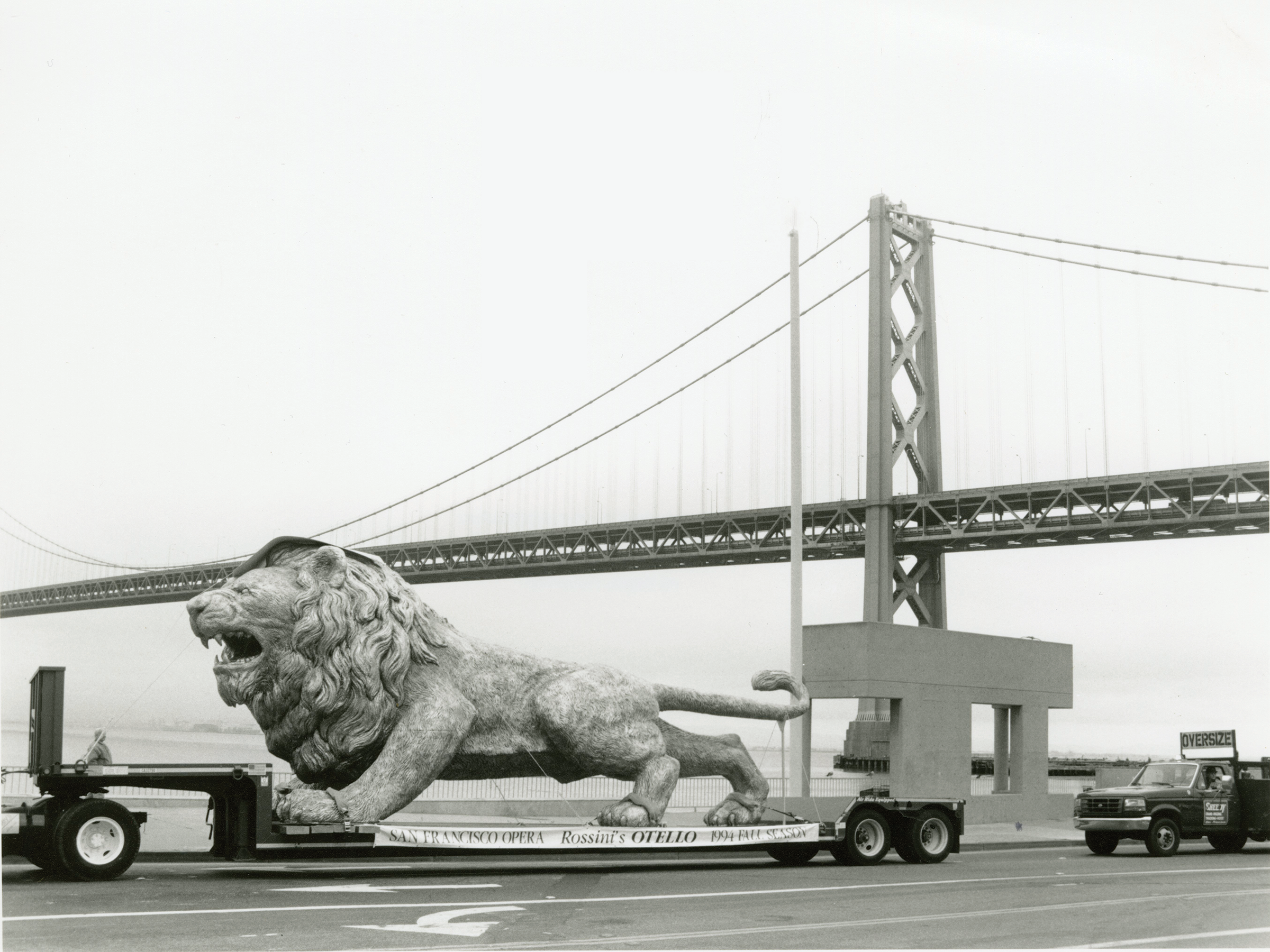
Yet another Rossini rarity was to follow. The 1994–95 Season brought Otello, the composer’s 1816 opera, which was not based on Shakespeare’s play but on a French source derived from it. The hard-to-cast work calls for not one but three fiercely ornamented coloratura tenor roles. Otello’s vocal fireworks in San Francisco were deftly mastered by Chris Merritt as Otello, Craig Estep as Iago, and Bruce Ford as Otello’s “heated rival” (to coin a phrase) Rodrigo.
What unusual Rossini might San Francisco encounter in the future? The answer may depend on what enterprising and agile-throated singers are available to do them justice. In the meantime, the perennial pleasures of The Barber of Seville will surely appease any current craving for Rossini’s bel canto delights.
Clifford “Kip” Cranna is Dramaturg Emeritus of San Francisco Opera.