

Ahead of the Wave
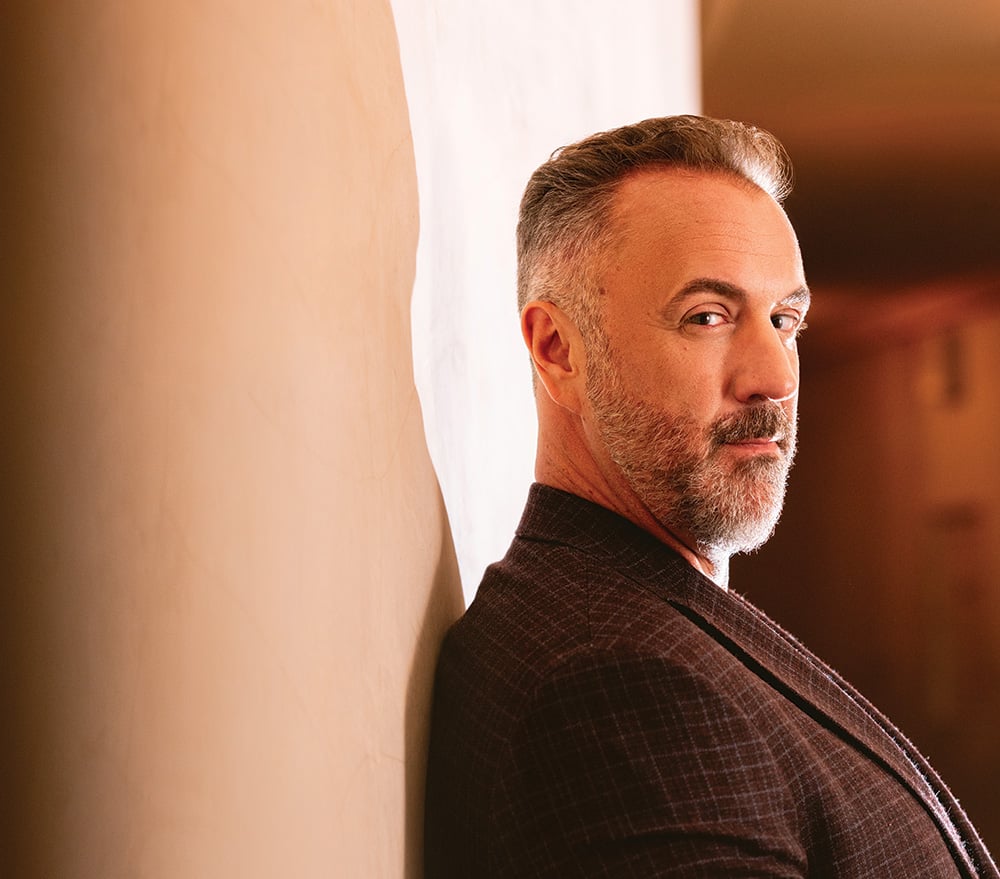
When Christian Van Horn steps on stage in San Francisco as Jacopo Fiesco in Simon Boccanegra this month, it will mark another milepost in a lifelong quest. “I’ve worked a long time to sing the big Verdi roles,” says the bass-baritone from Rockville Centre, New York. “Those were my dreams. I had to sing a lot of Mozart and French repertoire before somebody let me do that. I got into some bel canto, and then the Verdi thing started to happen, and it fit me like a glove. He knew how to write for the singer, and he knew how to write so that you sang healthy. It’s Mozart, in a way, for adults.”
Fiesco epitomizes the flawed but deeply human characters Van Horn brings so movingly to life. In a recent Facebook post, he accompanied himself at the piano, captioning it “A lifetime of vengeance dissolves in one moment.” “My eyes tear up just thinking about this moment,” he wrote. “This is, for me, the most beautiful passage in all of the repertoire for my voice.”
Van Horn brings both the rich, rolling sound of a true bass and the rhythmic pulse to give Verdi’s expansive melodies momentum. “In all repertoire, either you are singing it or it’s singing you,” he says. “Staying ahead of it—staying on top of the wave—is your greatest bet. When it comes to Verdi, if you’ve heard the music once, you can sing it back. That’s not the hard part. It’s text in rhythm before anything else. The text has to be so second nature to you that you are ahead of the wave. Because the second anything starts to slow you down, and the slog begins, you pull the maestro back, and then they pull you back further, and you start this tug of war ... You’re not early; you’re in front of the beat, in front of the action, in front of the drama. You’d better be, because it can run you over.”
Van Horn builds his vivid, detailed characterizations from the bottom up—literally. “When I’m cracking a score for the first time—I’ve seen the work, I know the breadth of the character and how far he has to go—I start to think: What kind of shoes does he wear? How does he walk? How does he stand? That sets the tone for the quality of the timbre: Is this a sad person? An aggressive person? Is he both? What is his goal? And from there: rhythm, language.”
Language is a vital tool for Van Horn. “I have found singing in French, you get a larger color palette. That’s not to say that you can’t bring all the colors of the rainbow into the Italian language, but you’ve got five vowels. In French you’ve got more options to explore. So there’s more space to explore. It makes it more interesting from a singer’s standpoint.”
Despite his passion for Verdi, it is a French role, Massenet’s Don Quichotte, with which he identifies with most closely. “When I finally sang Don Quichotte—and I’m not a 90-year-old man—but I understood the things that happened to him. I understood believing that your life should be more important than it is. I understood embarrassment. I understood losing love. I understood falling short,” he says. “Don Quichotte wears [these emotions] on his sleeve. So I felt closest to this character. I loved playing it! Emotionally, it takes a toll. When the show was over, I had to leave by another door because I didn’t want to greet people. I just wanted to disappear.”
“When I was a kid, I related to Figaro [in Mozart’s The Marriage of Figaro] because I was young and in love and full of energy, and you could think you’re the smartest guy in the room when you’re not. It was easy to relate to him. Now I don’t quite understand that guy anymore.”
San Francisco Opera debut of Christian Van Horn in 2010 as the King in Verdi’s Aida./Cory Weaver
Life Between Roles
The singer’s life, he says, is not for the faint of heart. “The only way this career works is if you are completely obsessed with it. You have to give up everything. Whatever comforts humans lock into—home, family, Christmas, knowing that you’re never going to miss a birthday or a funeral—we give up all of that. And while you seek out the approval and the applause of strangers, most of your life is spent alone, and that’s the price.”
Van Horn is thrilled to be back at San Francisco Opera, where he made his Company debut in 2010 as the King in Aida. “It’s one of the few places where you walk in and feel like you’ve joined a family,” he says. “For people who constantly sleep in strange beds and wake up not sure where they are, San Francisco feels like home because they’re so happy you’re there. Companies sometimes forget that 10 months out of the year, we’re in a strange place. When you’re greeted like an old friend and the first thing they ask you is how you’re doing—not, ‘Are you ready to sing? We need you to do this, this, and this’—few places are nicer to work.”
Van Horn performed Offenbach’s villains in Les Contes d’Hoffmann, 2013/Cory Weaver
San Francisco Opera audiences have loved Van Horn from the start. He speaks just as warmly of San Francisco audiences. “It’s an intelligent crowd,” he says. “A lot of places have to put on the greatest hits every year to keep their audience. In San Francisco I sang Two Women, Les Troyens, Orlando, Billy Budd. And the audience jumps right in!”
Beyond the Stage
During the pandemic, Van Horn launched The CVH Podcast. “I realized that I was talking to the audience in a performance,” he says. “This was a conversation we were having. Our lives and our artistry are interwoven with these characters that we play, and we have people that follow us and know us, and I wanted to connect with them. I made sure that whatever I did on the podcast, it would remain honest. I wasn’t going to paint a picture of some charmed life—although much of it is charmed—but I was going to talk about the realities of life in this business.” Guests have ranged from star singers to his son, Colter, but he notes, “Most of the time, it’s just me, and the response is nothing short of a miracle. It’s turned into the best marketing thing I ever did. I’m in the process of putting out a self-titled debut album, and the presales have been shocking because I’ve got this fan base that I talk to once a week.”
In 2024, Van Horn, as Escamillo in Bizet's Carmen, made his entrance on horseback./Cory Weaver
That album, he says, is “completely do-it-yourself. I’m the executive producer. I procured funding; I got the orchestra, the hall, the maestro. My hope is that I’m going to pave the way for other artists because the classical-music recording business is over. I think this will be a tiny glimmer of hope for the future of classical recording—that it’s possible to do this on your own.”
The whole project is homegrown, right down to cover art created pro bono by one of his podcast fans. “Her name is Roxana Zegan, and she is an award-winning creative director. She had seen me at the Met, and she started listening to the podcast. We became friends, and I learned that she had made two album covers for a leading rock-and-roll band. I said, ‘Now Rox, I can’t afford you, but would you want to take a stab at the album cover?’ She was so excited! So you say DIY, but there are hundreds of people involved. It’s been exciting to see where the love and support come from.”
That love and support help balance the sacrifices. So does the work itself. “I get to be a storyteller,” says Van Horn. “I get to sing songs for a living. I don’t have a desk; I have a piano. If I don’t like my boss, I get a new one in three weeks. If I have a bad show, there’s tomorrow. The scenery keeps changing, and that keeps your brain and life active. This is a rare life that I’ve been offered, and shame on me if I don’t do it.”
Louise T. Guinther, former senior editor at Opera News magazine, is an arts writer based in New York.