

Manon Becomes Her
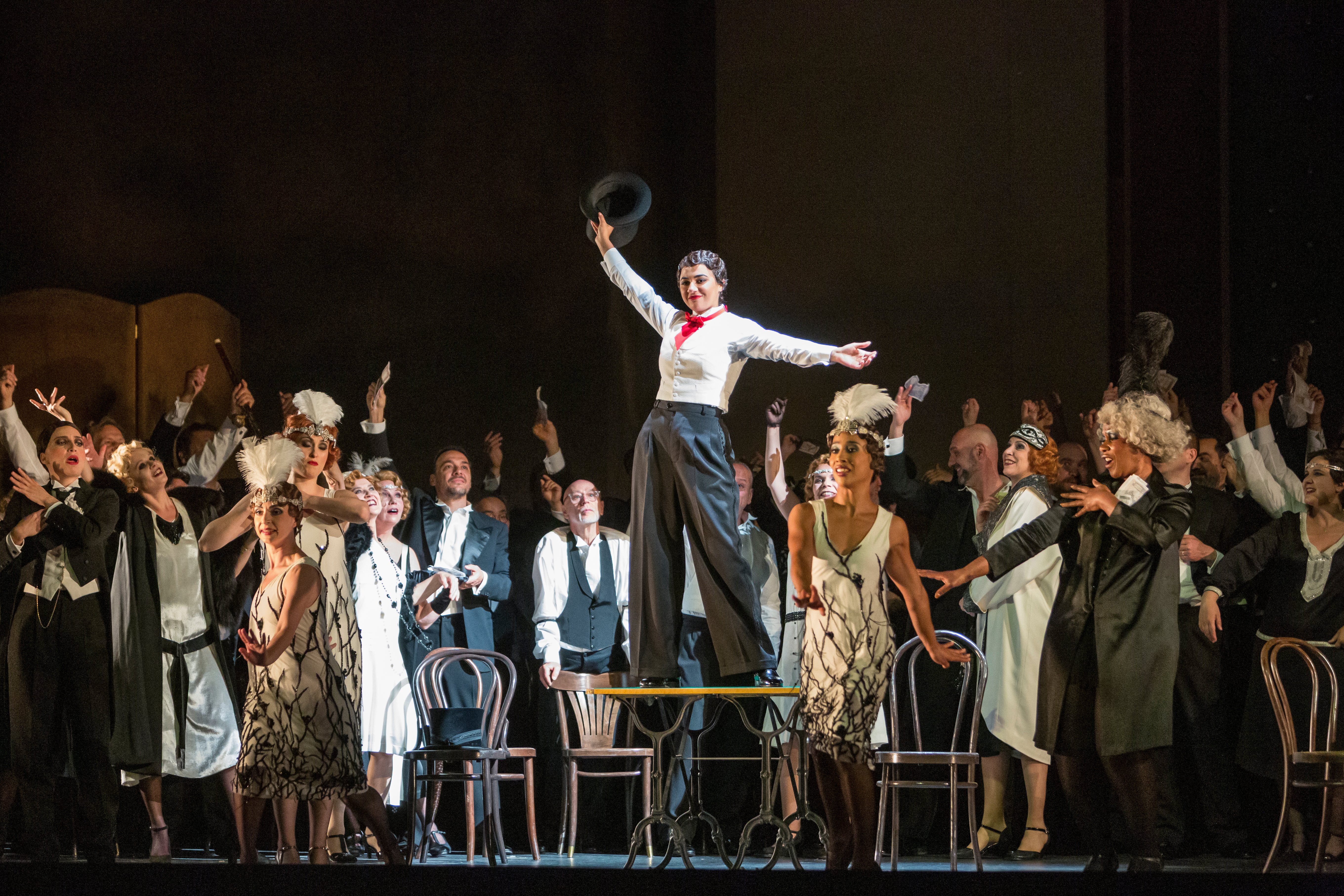
With Amina Edris’ return to San Francisco Opera this season, the Company is welcoming back one of its own. Since training here, she has built an international career with a particular affinity for French repertoire. Now she returns in one of her signature roles, Massenet’s Manon, opposite her husband, tenor Pene Pati, as Des Grieux.
Born in Egypt and raised in New Zealand, Edris studied there before continuing her training in Wales. A visit to San Francisco, where Pati—then her fiancé—was participating in the Merola Opera Program, altered the course of her career.
From there, things moved quickly: Under César Ulloa’s tutelage, the young soprano earned a post-graduate diploma at the San Francisco Conservatory of Music, then spent a summer in Merola before being invited into the Company as an Adler Fellow.
Edris’ two years as an Adler Fellow were vital, enabling her to observe a world-renowned opera company in depth. Always intensely dedicated to her work, she spent as much time as possible at the opera house: “Whatever we’re taught at music schools and conservatories is one thing, but what you experience in an opera house on a daily basis is something else! Understanding its inner workings, the dynamics within the rehearsal room, watching the greats rehearse and perform—you can learn so much just from that.”
Edris with her uncle, Mamdouh Edris, at the Dahab Island Palace filming In Song: Amina Edris. / Mostafa Abdel Aty
Edris made her Company debut in 2016 as Frasquita in Carmen—an early step in what would become a deep association with French repertoire. After several smaller roles here, she returned in 2019 for her first leading role with the Company, Gounod’s Juliette. Three years later, she created Cleopatra in the world premiere of John Adams’ Antony and Cleopatra.
Singing Juliette (a portrayal subsequently reprised in Dresden, Paris, and Los Angeles) was especially memorable for Edris in San Francisco: “It was such a crazy thing,” Edris recalls, “a full-circle moment, to grow up at this opera house, then to come back in a role I loved very much and to do it alongside Pene!” Her single performance as Juliette had been scheduled from the outset. Cleopatra, by contrast, came at the last minute: Edris had just a month to learn some of the hardest music she had ever sung. “I couldn’t have done it at any other opera house. The entire music staff rallied around me and supported me in a very special way.”
French repertoire has become a through line in Edris’ career: Barely a decade in, she has sung 16 French roles, by her count. “You really have to lean on the text in whatever language you’re singing. There’s a specific sensitivity and nuance that’s required in French music.” Fluent in French since childhood, Edris revels not only in phrasing Manon’s music but also in speaking her dialogue: “With any text, it’s challenging when you have an orchestra underneath you in a big hall and have to project your speaking voice. You can’t do it with the same intimacy as you would in a smaller space. But I enjoy the dialogue very much—it’s a big part of the character.”
Edris is equally drawn to the specificity of Massenet‘s writing. She likes to view him as the French Puccini and Puccini as the Italian Massenet, “both in the way they tell a story and in how detailed they are. When you open one of their scores, you see exactly what they want on every page and how they want it interpreted. There’s very little guesswork, but that doesn’t mean you don’t have agency to explore and interpret.”
As Juliette in Gounod’s Roméo et Juliette, 2019/Kristen Loken
Manon’s complexity fascinates Edris, who considers her “more than what people believe her to be on the surface. Massenet develops her musically to match dramatically what goes on in her life as the opera progresses. The music for the girl starting out in Act I is an entirely different world from where she is at the end of Act V! There’s an evolution, a huge arc, with so much room to grow.” The role’s physical transformation is just as important to Edris. “I’m very different in Act I from Act III, when I appear at the Cours-la-Reine. The way I move, interact, or even look at people is different. Manon has a complete transformation—she‘s now the person she’s been pretending to be.”
Manon is ambitious, driven, and passionate—qualities Edris recognizes in herself. “She and I have all of that in common,” she notes with a laugh. Just as important, though, is keeping the character sympathetic. “When I first set foot onstage, I’m not playing manipulative or conniving. That’s a trap that many singers fall into, but it’s not the game she’s playing. She’s just a foolish 16-year-old who’s trying to escape the convent! It’s important that with every action, every decision, I’m always thinking there’s sincerity involved. That goes especially for her feelings toward Des Grieux. An aria like ‘Adieu, notre petite table’ wouldn’t exist if she just wanted to up and leave the moment she was given the opportunity.”
In 2017, during her Adler Fellowship, covering Manon gave Edris “my chance to learn it inside out, upside down, back to front. I had access to the Company’s incredible music staff, who could help with every aspect of the piece.” Luckily, that production’s conductor, Massenet specialist Patrick Fournillier, and the Company’s French diction specialist, Patricia Kristof Moy, were both delighted to coach Edris. As a result of that extensive preparation, when making her 2019 role debut—and European debut—in Bordeaux, “I felt very calm.” Since then, she has performed Manon in Barcelona and in two Paris Opera runs at the Opéra Bastille, in 2020 and 2025.
At Golden Gate Park for Opera in the Park, 2019./Drew Altizer Productions
Among the role’s pleasures for Edris is “N’est-ce plus ma main?”—Manon’s seduction of Des Grieux at the Church of Saint-Sulpice. The role does pose some vocal challenges, particularly the Gavotte in Act III (“It comes out of nowhere, and my voice suddenly has to sit in a slightly higher register”). The last two acts require a bit more vocal heft than the rest. But, as Edris gratefully notes, Massenet structures the role with unusual care so that “you’re not screaming for thirty minutes at a time!”
Before returning to San Francisco for Manon, Edris and Pati performed the opera together with Wellington Opera in August. Speaking over Zoom in June, Edris was already thinking ahead to the opera’s tragic final scene. “Such beautiful, heartbreaking music. Manon is apologizing for her past mistakes, and Des Grieux responds with such kindness, openness, and acceptance.” Singing Manon with her husband in Barcelona, “it got so emotional that there wasn’t a single night when we both didn’t cry.” Edris cherishes Pati as “a very giving partner onstage. I hope I give him the same love, care, sincerity, and honesty that he gives me.”
Beyond Manon, Edris has explored two other Massenet roles. In 2024 she sang Thaïs in Toulon and will reprise the role in Geneva in March 2027. She calls Thaïs “vocally a beast! It’s very difficult musical writing. She’s a whole lot of woman and has her complexities—the inner demons she’s fighting.” A more rarely encountered Massenet work, Ariane, brought Edris to Munich for a concert performance in 2023. She found the story “too flawed to put onstage, but the music is exquisite, and I had an amazing time singing it.” The Munich performance became the work’s world-premiere recording for Palazzetto Bru Zane; Edris also appears as Alice on the label’s recording of Meyerbeer’s Robert le Diable.
Edris created the role of Cleopatra in the world premiere of John Adams’ Antony and Cleopatra in San Francisco, 2022./Cory Weaver
Edris’ French repertoire extends well beyond Manon and Juliette, including Micaëla, Marguerite, and all four heroines of Les Contes d’Hoffmann. Her musical curiosity drew her to Gounod’s Sapho for Washington Concert Opera, in which she portrayed Glycère, the devious courtesan; “the only time I’ve ever played a character like that—and I loved it!” But her most unexpected departures, stylistically speaking, have surely been two Rameau operas. In each case, “it was the people involved who led me to the work. Fatime in Les Indes Galantes [in Geneva] was with a wonderful team, offering me a great opportunity to try that repertoire out.” Then, in Paris, came the delight of playing one of French Baroque’s dizziest, wildest, most hilarious characters, La Folie in Platée. On that occasion it thrilled Edris to reunite with conductor Marc Minkowski and to appear in Laurent Pelly’s production, “which I love-love-love and am obsessed with. It was brilliant—so funny and so intelligent. La Folie gave me a chance to step outside of the more romantic, more serious characters. I enjoy being silly onstage!”
There are other French heroines Edris hopes to explore—Mireille, Louise, Mélisande, and—topping her wish list—Poulenc’s Blanche in Dialogues of the Carmelites. For now, though, Manon brings Edris back to San Francisco in a role that offers exactly the range she prizes. In Massenet’s opera she finds “a little bit of everything. There’s the romance, some comedic moments, and the more dramatic moments especially toward the end. You want the audience to feel and go through the emotional rollercoaster that we’re going through onstage. I hope they’re moved by it.”
Roger Pines is a contributing writer to Opera magazine (U.K.), programs for opera companies internationally, and major recording labels. A faculty member of Northwestern University’s Bienen School of Music, he has also been a panelist on the Metropolitan Opera’s broadcast “Opera Quiz” since 2006.