

Dark Visions & Radical Optimism
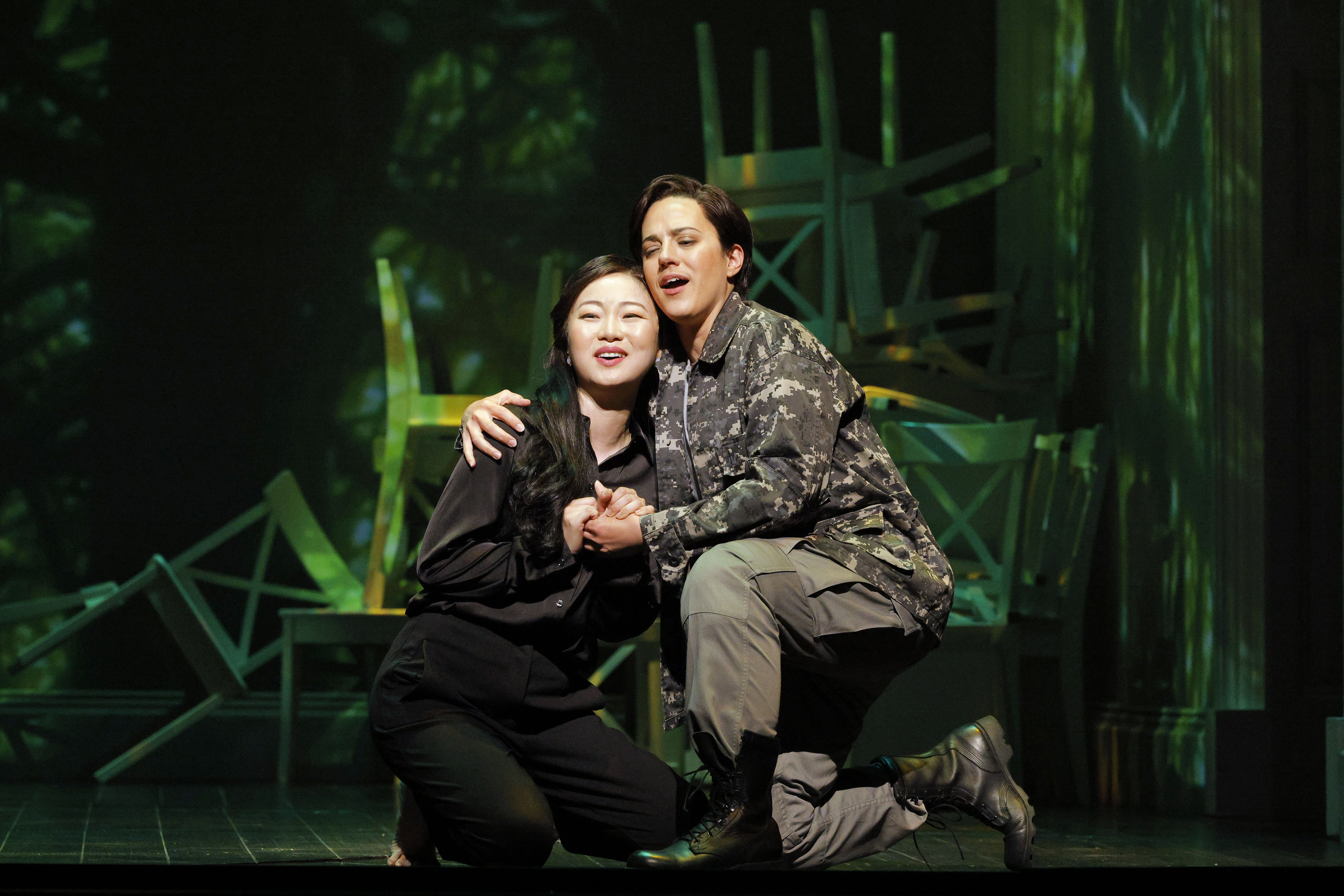
War, and its fallout, is inescapable in Idomeneo. Today we’d say the characters all have forms of PTSD. Ilia, the daughter of Troy’s King Priam, mourns the loss of her father, brothers, and homeland, all destroyed by Agamemnon’s army. Elettra, Agamemnon’s daughter and Ilia’s love-rival, is damaged beyond repair by the horrific violence wrought in her family. She veers between extreme euphoria and acts of self-harm. Pummeled by the elements, Idomeneo has the untethered, homeless quality of King Lear or his colleague in war, Odysseus. Obsessive yet unable to act decisively, he is an ambivalent, fragile king. Yet as one of Agamemnon’s generals, for ten years Idomeneo was a killing machine. We know he rode in the belly of the famous wooden horse through Troy’s gates, so we know he participated in the infanticide, rape, murder, and looting that followed, culminating in burning the great city to the ground. In doing so he has earned both the wrath of Neptune and the bloody nightmares that haunt him. The conquering warrior returns to Crete older, bloodstained, debased, ashamed, in psychological pain: flinching at his son’s affection, behaving irrationally. Internally compelled to atone, yet publicly lauded, Idomeneo is unlike any other of Mozart’s characters.
A fascinating detail to note is that the celebrated tenor Anton Raaff was nearly 67 when he created the role of Idomeneo at the work’s premiere in 1781. An eminent composer himself, Raaff had sought the collaboration with Mozart. He was influential in proposing that the work’s commission should go to the 25-year-old composer and despite his waning powers did not flinch from its monumental vocal demands. Raaff’s retirement from the stage after Idomeneo, a role like no other in his stellar career (quite the mic drop for Raaff!), resonates movingly as a parallel to the arc of the opera. Raaff cannot but have expressed the deep emotion of Idomeneo’s final scene, the exhausted king relinquishing his powers to the next generation, without imagining his own.
The “wine-dark sea” of Homeric legend courses through the heart of Idomeneo. Manipulating the flawed humans is Neptune (Poseidon in Greek mythology), the god of the sea. Promised a human sacrifice to save Idomeneo and his men from drowning, Neptune’s anger grows through the opera as the king prevaricates and resists the “barbarous” and seemingly implacable god. But just as Idomeneo is at the point of finally sacrificing his son, Neptune changes his mind. In a deus ex machina worthy of Aeschylus, the god releases Idomeneo from his vow and humbles him, revoking his power as ruler of Crete. Mozart and his librettist Giambattista Varesco magnificently conjure the sea’s power with two stunning sea-storms and a sea-monster before calm is restored. Idomeneo’s heroic tenor aria “Fuor del mar ho un mare in seno” (Far from the sea, I have a sea in my breast) expresses his turmoil enduring Neptune’s cruelty.
Ultimately, like all myths, Idomeneo is an exploration of humanity. Its scope encompasses extreme (individual and collective) human psychologies and behaviours, rational vs. irrational thought, the trauma and social disintegration that result when crisis threatens the status quo, as experienced with the Covid pandemic and very recently, the catastrophic bushfires in California. Written in 1781 by an idealistic 25-year-old amid epochal social upheaval, Idomeneo’s themes are ancient and utterly modern. For contemporary audiences reflecting on a period of darkness or communal trauma, there are surprisingly powerful resonances drawing us to its Enlightenment-era ideas.
Mozart’s Masonic lodge was called New Crowned Hope, and indeed this opera ends with hope for a brighter future, a celebration of love, and a new king. By Neptune’s decree, Idamante will immediately replace his father on the Cretan throne, and beside him will sit Ilia. This union of former enemies moves Crete a generation closer to peace. Suddenly at the end of his struggles, Idomeneo publicly relinquishes the crown with final words that are tender, gracious, and tinged with relief: “Behold: this beautiful couple is a gift bestowed upon you by heaven. You all have reason to hope! O fortunate Crete! How happy I am!”
There is radical optimism in the final chorus of Idomeneo, an idealized vision of renewed community leadership, a reordering of social values and philosophies, a contemplation of what we’re handing on (the good and the bad) to the next generation. In this context, this new production seeks to explore concepts of order and chaos, renewal, community, and empathy.