

Voices from the Pit: San Francisco Opera Orchestra Musicians Discuss Richard Strauss’ Elektra
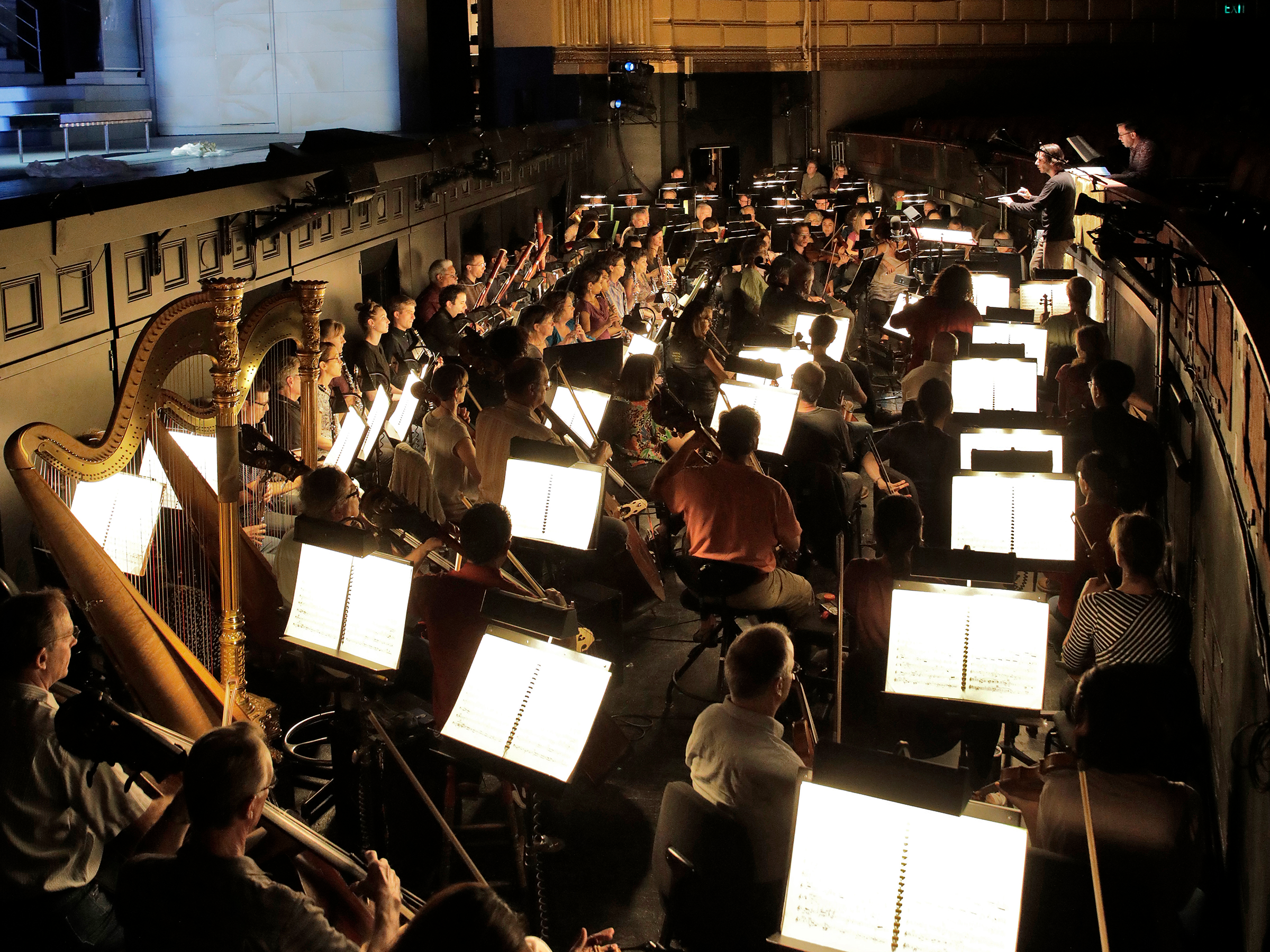
With the Company premiere of Elektra scheduled for late October 1938, San Francisco Opera founder Gaetano Merola knew his guest conductor, Fritz Reiner, would arrive in San Francisco with great expectations. At the very least, the notoriously irascible maestro would require a proper Straussian orchestra. Merola could find the musicians, but seating them presented a problem: the War Memorial Opera House pit was built to accommodate around 70-80 musicians for Verdi and Wagner operas; not the near-100 instrumentalists that Strauss calls for in Elektra.
The Opera House was only six years old and likely still had that new-car smell when the Elektra-fication of the pit began, including the addition of a new four-foot-wide enclosure under the stage spanning the length of the pit. That space, affectionately called the “Torpedo Room” for its resemblance to the inside of a submarine, continues to be used by the Orchestra today.
Elektra is one of the early paradigm-shifting works in San Francisco Opera’s 103-year history. Along with other large-scaled operas like Strauss’ Die Frau ohne Schatten in 1976, Messiaen’s Saint François d’Assise in 2002, and Berlioz’s Les Troyens in 2015, Elektra pushed both artistic and physical boundaries, expanding the Company’s creative capacity. The San Francisco Opera Orchestra’s Principal Harp Eleanor Kirk, Acting Principal Percussionist Patti Niemi, Principal Bassoonist Rufus Olivier, Principal Second Violinist Jeremy Preston, and Director of Music Administration Matthew Piatt discuss returning to Strauss’ intense and mammoth masterpiece in June 2026.
How are you preparing for Elektra?
Niemi: We spend time getting different percussion instruments that we want to use—cymbals, tam tams—and see what we can fit in the pit.
Preston: Strauss tries to get the most technically out of the violins in this opera, more than probably anything else that had come before it. I do a lot of slow practice.
Kirk: I take a look at the larger trajectory of the music and make sure I’m familiar with the synopsis so I know what we’re supporting in the pit. I listen to a variety of recordings with the score and prepare myself for a range of different tempi and make sure I’m familiar with the opera’s sonic world. Opera harp parts often include long tacets, or periods of quiet, so I want to make sure I have a lot of cues in my part. Then if I hear a particular moment in the score, I’m ready to go with my next entrance.
Olivier: I don’t listen to the opera ahead of time. The first time I hear it is at the first rehearsal. I’ve been doing it that way for 50 years, and I still get excited when I hear something new. With something like Elektra, I get my part and go through it slowly every day until it becomes part of my body so I’m not even having to think about it. I’ve always been a believer in keeping the instrument in your mouth, because playing, playing, playing is how you get it into your body. By the time you get to rehearsal, whatever the conductor wants you’re able to just do it.
Piatt: I don’t know if it’s specific to this Strauss opera or it’s me getting older, or both, but there’s something about music that is this complicated and saturated with information, that I find myself doing much more slow, deliberate practice. Within Strauss’ polytonality you keep discovering motives, which are sometimes hidden in a complex musical language. It’s kind of like standing up close to an impressionist painting; you really appreciate the detail up close. And then, when I get to playing it at tempo, I will, of course, be leaving things out, but that preparation has been important for internalizing the music and feeling like I have mastered it as much as I can.
What role does your instrument play in the opera?
Kirk: The cool thing about the harp is we can play many different roles within the ensemble. We can accompany a line like a solo clarinet line or concertmaster solo, play in big tutti sections to add to the texture, or play very solositic cadenza-like passages. In Elektra, we get to do a little bit of everything, and switching between roles throughout really keeps us on our toes!
Niemi: The percussion instruments are divided, I would say, into three sections, the first being metal: glockenspiel—the only mallet percussion instrument in Elektra—triangle, tambourine, and cymbals. All the metal sounds are mostly thrown in there for sound effect. The second category is wooden, the castanets. Those are usually used in opera for a Spanish effect, like in Carmen. In Elektra, they are nothing like that; they’re chaotic. Then there is an instrument called the rute (pronounced “route-a”), which is like a collection of switches that make a whip sound.
Preston: The work for the strings is divided into three sections, and, actually, sometimes into four. It’s eight violins on each part. It’s very technically demanding. Strauss will use tremolo, col legno, and fast motion to show all the anxiety. He’ll use a lot of ponticello, which is when you play really close to the bridge creating a glassy sound. He uses extreme ranges, and also chromaticism for this super-slimy feeling, as if to show what it feels like when Elektra is thinking about Klytemnestra. I’m playing the third violin part in this one. That part is more percussive. There are more small gestures, and you rely less on the other violins, so you have to really be there and ready to turn on a dime.
Niemi: I think all Strauss is exciting for percussionists because those operas involve a lot of instruments and a huge orchestra. Percussion is always used to great effect. I’m thinking mostly of Salome, Elektra, and Der Rosenkavalier. And there’s just so much drama! In the first two, you have a girl who dances, goes crazy, and dies, all in an hour and 40 minutes. Elektra is awesome!
Are there specific moments in the opera that audience members should listen for your instrument?
Olivier: We are like the background music in a movie. Whenever something bad happens, it’s usually depicted in the orchestra. In my case, there is a scene where Elektra is talking to her mother about bringing her brother back because he has been sent off. Klytemnestra is saying he is lazy and that he stutters, and the bassoon is playing what they’re saying about him.
Kirk: The very first entrance of the harp in the opera, about eleven minutes in, occurs when Elektra sings: “Father Agamemnon, your day will come from the stars. All time comes crashing down. So will blood from a hundred throats come pouring onto your grave.” The harp enters when she sings the word “Stars,” or “Sternen” in the original German. It’s quite interesting and meaningful because the harp is used there to represent the transition between worlds. Here between the heavens and the earth, and the harp often represents these liminal spaces and transitions in Greek Mythology, as with the underworld and the world of the living in the story of Orpheus and Eurydice.
Elektra has the largest ensemble of almost any work in the repertoire. What is it like performing in the pit with 95 instrumentalists?
Piatt: It’s staggering. Just the sheer number of people in the pit is part of the experience. I don’t want to say “over the top,” but it’s kind of over the top [Laughs]. Despite how many people are playing, Strauss still gets these moments of transparency. You’re never going to hear or grab onto every leitmotif, but there’s something about the speed that keeps it suspenseful.
Kirk: Last fall it was a bit crowded in there for Parsifal. I know Elektra will be even more crowded, but it’s going to be great. It’s so special to be a part of a big orchestra and just feel like you’re contributing to that sound, and with close quarters you develop a real sense of camaraderie with your colleagues. In a crowded pit, you really feel like the whole orchestra comes together both literally and figuratively. I’m really looking forward to it.
Niemi: The pit is always tight, and, surprisingly, it changes every time as there are always different bodies and their chairs. So even though we’ve done Elektra before, I’m sure we’ll get in there at rehearsal and start jockeying for space.
Kirk: Sometimes we have platforms in the pit to elevate us because the harps are usually towards the back. It helps with sightlines and to amplify our sound, but it also provides a little area that cannot be infringed upon as we do need a bit more space in the pit. The harp is a large instrument that weighs 85 lbs. And we use our feet to pedal, so we need space around the base of the harp to move the pedals. And we play, you know, like this [demonstrates with elbows out on either side of the strings] we literally need elbow room.
Olivier: I approach each opera as, okay, let’s play this thing. Is that eight clarinets sitting to my right? That’s enough to call the police! But no problem; after you’ve played [Messiaen’s] Saint Francis of Assisi, there’s nothing more packed than that. We were literally spilling out of the pit! I don’t move a lot when I play, so as long as I just have enough room for my elbows it doesn’t bother me.
Preston: It gets very tight for Elektra, and your movements are more constricted than usual. In some ways, I think that helps us be more attuned to what is going on on the stage. But, it’s also extremely loud at times because you have so many instruments blaring away at once. Sometimes you have to wear earplugs, which means you have to use your visual senses a lot more.
Do you have a favorite moment in the score?
Piatt: In the recognition scene after Orest arrives, Elektra has this beautiful A-flat Major section. That’s one of my favorite parts, actually it is one of the only quiet, reflective parts in the score.
Niemi: This might sound weird, but my favorite part of the opera is the opening. It’s not like we’re going to slowly get you into this story of a man who sacrifices his daughter, who is then killed by his wife, so the son then kills the mother. It just starts, and the audience feels all that. And the end is overwhelming. We have two timpani players and another three percussionists, and it just builds to that point with every instrument coming in. I’ve been here 34 years now, and it is still incredibly exciting, and I have a front row seat to everything. That is the best part of my job.
Preston: I love the ending—it feels like this deranged, almost waltz-like dance. Strauss builds relentlessly, and then suddenly you’re swept up into this triple-meter surge. But it’s unstable, dissonant—almost unhinged. It feels like an old Viennese waltz colliding with something modern and brutal. You’re lifted up, only to be hurled back down again—like Elektra, completely consumed by revenge.
Do the intense emotions of this piece affect you before or after the opera?
Preston: Before we start, you’re set to experience psychological warfare for an hour and 40 minutes, and that kind of influences your day. You have to prepare yourself for something very dark. It’s not old-world Vienna, charming and beautiful. Elektra is the stark opposite of that, and you don’t get a lot of relief. But then, when they come, the beautiful melodies kind of make it all worth it, because it’s so human and so tender. After operas like this I tend to walk home at night just to physically get it out of me and to maybe spend some time doing mindless things. It’s important to take care of yourself.
Niemi: When we did The Elixir of Love a couple of years ago with Pene Pati [November 2024], I felt emotionally involved because it was so stunning. It’s just a fun opera, but the audience and the singers were so invested that it got to me every time. Elektra is torturous, dramatic, violent, but as an orchestra musician I don’t take any of that on. It’s more the thrill of performing it.
A special question for Mr. Olivier who has been with the Orchestra since 1977 and played five productions of Elektra. Is there one Elektra memory that stands out?
Oliver: Yes! With Dame Gwyneth Jones in 1991. We’re rehearsing, and the Orchestra is on afterburners. We’re cranking it, man. And Gwyneth is up there singing Elektra, and she is really cranking it, too, you know? The ceiling is shaking, and the brass guys were in heaven. The conductor stops us and asks Gwyneth, “Is the orchestra too loud in that spot?” And she said, “What orchestra?” [laughs] You could hear her out on Polk Street!
Welsh soprano Gwyneth Jones as Elektra (with Helga Dernesch as Klytemnestra) in the 1991 production./Marty Sohl
Public Relations Director and program editor Jeffery S. McMillan is a writer on opera and jazz.
Special thanks to Music Assistant Nina Pitts and Editorial Consultant Jeanette Yu for help conducting the interviews for this article.