

Gathering Us Around:
Dead Man Walking a Quarter Century Later
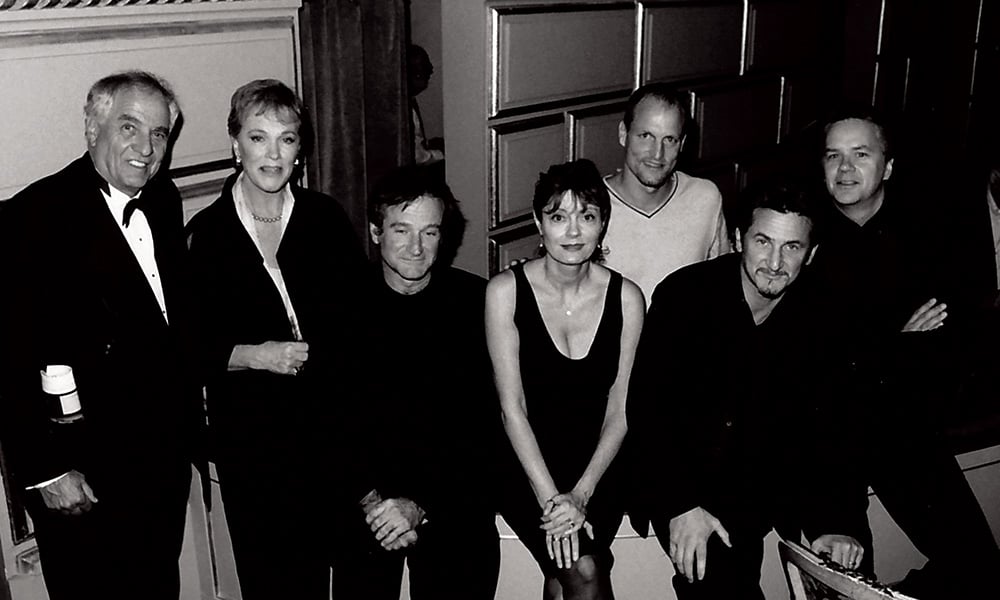
Someone mentioned to me recently that the success of the opera Dead Man Walking came out of nowhere. I chuckled. Did we know at the time that we were involved in something special? It would make a cleaner story to say we did, but we didn’t. We knew that an epic group of people had assembled: Susan Graham, Flicka (Frederica von Stade), Kristine Jepson, Bob Orth, John Packard, Joe Mantello, Michael Yeargan … so many, all united by a deep belief in Jake Heggie whose assigned task was a formidable one. Did we know it would work? No.
Sister Helen Prejean famously opened her 1993 book, Dead Man Walking, with these words:
I’ve heard that there are two situations that make interesting stories; when an extraordinary person is plunged into the commonplace and when an ordinary person gets involved in extraordinary events.
Jake Heggie, uniquely, is both of these scenarios at once. On the extraordinary side he is a gifted composer and creator, an empath, a collaborator, a storyteller, an activist, and a champion of those he respects, starting with the audience. But he is also that “ordinary” person to whom anyone can relate: a homebody, loving husband, quick to laugh. thoughtful, and generous. If you are a friend of Jake’s, you will never know a better friend. This isn’t at all ordinary in life, but he would describe it as such, so we have to take his word. And another thing for the “ordinary” column: Jake didn’t know if he could create a work like Dead Man Walking. Indeed, when he told his mom—beloved Judy—that San Francisco Opera was asking him to compose an opera, she said, “Can you do that?”
The one person who did know was Lotfi Mansouri (San Francisco Opera’s General Director 1988–2001), who took a huge risk with this opera that he didn’t have to take, and no one talked him into it. Lore has taken over much of this story—as it always does—but my recollection was this: I was involved in the development of André Previn’s opera A Streetcar Named Desire, conducting half of the performances with André in 1998. In an early meeting about Streetcar and various other projects, Lotfi casually mentioned to me how happy he was that André had finally agreed to compose Streetcar, fulfilling Lotfi’s lifelong dream for an opera on the epic Tennessee Williams play, and “wouldn’t it be wonderful after Streetcar to have an unknown composer and an unexpected subject for the millennium?”
It was during that meeting that I mentioned Jake as a possible composer. No one could portray incredulity quite like Lotfi, and at that moment I got the look. “Yes,” I said to his doubting face, “that Jake.”
I don’t believe I was the first person to mention Jake’s compositions to Lotfi, but he acted like I was. I told him to speak to Flicka, Bryn Terfel, Renée Fleming—the singers who were already championing Jake’s songs by that time—and he did. Jake had started working in the San Francisco Opera press office in April 1994, and within a few short years he was the Company’s composer-in-residence with a commission for an opera to premiere in the 2000 fall season. This was classic Lotfi and right out of one of the Hollywood movies that he loved. Lotfi was a believer and a risk-taker. Once he had an idea, which he certainly had with Jake, he would never let go of it, and he always had the courage to be wrong, which is a wonderful quality in a leader. With Jake and Dead Man Walking, Lotfi turned out not only to be right, but he was ahead of his time. Unfortunately, he wouldn’t live to see the full impact this opera would have.
Speaking of movies, Lotfi’s original ask of Jake was for a comic ensemble opera in French based on the 1934 film La Belle de Nuit about a man who seeks vengeance on his cheating girlfriend by hiring a prostitute who resembles her (but it’s a comedy!). Obviously (perhaps thankfully), the French comic opera never happened. It was Lotfi’s brilliant idea to bring on Terrence McNally as the experienced hand to develop the idea and write a libretto for the inexperienced Jake. It took some convincing for Terrence to agree, but once he did, he was a force and became the theatrical granddad of all of us.
We are too quick to forget how much contemporary opera Lotfi programmed during his tenure in San Francisco. One of his earliest programmed works was Philip Glass’ Satyagraha, and the Company was among the consortium who commissioned the 1991 John Adams opera, The Death of Klinghoffer. There were also wonderful performances of Hans Werner Henze’s Das Verratene Meer, and Stewart Wallace’s Harvey Milk played to admiring crowds more than a decade before Sean Penn played San Francisco’s famous civil rights leader in the 2008 film Milk.
It was Conrad Susa’s 1994 commission, The Dangerous Liaisons, that was a turning point on many fronts, including for Jake. While obviously based on the 1782 novel, it was really commissioned because Lotfi loved the glittering 1988 Stephen Frears film of the same name. How vividly I remember everyone gathering backstage at every performance just to hear Renée Fleming sing the most perfect high B-natural in the western world with “Valmont is dead!” The Dangerous Liaisons was a hit with the San Francisco public, and it gave Lotfi new life to find his composer for Streetcar, which in turn gave him the courage for Dead Man Walking.
Looking back, there were reactions to Dead Man Walking that appear retrospectively quaint. There was a visceral reaction to creating operas out of popular film titles, though for Jake that was an illogical, non-historical argument. The fact that Dead Man Walking had been an acclaimed 1995 film for which Susan Sarandon won an Academy Award for Best Actress, was no detriment to an opera only a few years later. Indeed, telling a story for which the audience already had a nodal point was highly desirable to both Jake and Terrence.
The year 2000 (remember “Y2K?) was a big year for new operas besides Dead Man Walking. That spring, I conducted Carlisle Floyd’s delightful and moving Cold Sassy Tree in Houston, and I recorded Mark Adamo’s Little Women with Joyce DiDonato. 2000 also brought Kaija Saariaho and Amin Maalouf’s L’Amour de Loin in Salzburg, Michael Nyman’s gorgeous Facing Goya, Poul Ruders’ searing The Handmaid’s Tale (performed last season by San Francisco Opera), Michael Berkeley’s beautiful opera on Jane Eyre, and Adams’ El Niño in Paris.
But a bigger trend was emerging: 21st-century opera was becoming an American art. Since 2000, more than 300 new operas have been created in the United States, a pace of creation not seen since the years between Wagner’s Parsifal and WWI. Viewed through opera’s meta-history, opera began as a remnant of the Florentine and Venetian empires in the 16th century, spread across Europe and flourished through the early-20th-century world wars, and immigrated, creatively-speaking, to America. Yes, opera is an immigrant to our shores, as are many things, from our constitutional republic to every imaginable culinary delight.
American Opera in the immediate post-WWII years was a lean field, led by Carlisle Floyd, Gian Carlo Menotti, Robert Ward, Samuel Barber, and Leonard Bernstein in their various ways though never quite finding a broad public. Europe was scarcely more robust in those years, Benjamin Britten and Francis Poulenc notwithstanding. But the American Musical during the same time was incredibly robust, holding within it the Rodgers and Hammerstein revolution, which was considered both of high quality and of high artistic risk in its day, Lerner and Loewe, Bernstein (he always straddled all creative worlds), Jule Styne, and the complete 1970s reordering of the American Musical by Oscar Hammerstein II’s mentee, Stephen Sondheim.
Fast-forward to Dead Man Walking and the last 25 years, and those worlds have reversed themselves. Newly created musicals are rare, while only a generation ago there was a Hamilton-level hit musical nearly every season. Now, if you’re seeking innovative musical storytelling, you’ll find it not in the commercial theater but in the opera house. There are more living composers today who have heard their own operas performed than has happened since Puccini’s era.
Jake Heggie is a composer in opera’s grand tradition—big, symphonic, choral, expansive—and his musical language brings that past together with a post-Sondheim kind of songwriting. He loves the expressive possibilities of the human voice, a quality he shares with the greatest of the legacy opera composers, but he has also always had his own voice—you can hear it from the first moments in Dead Man Walking.
Opening night of Dead Man Walking feels like it just happened, so the “25th Anniversary” this season is surreal for many of us. How deeply I recall everyone looking for Sister Helen that night as we neared curtain time. She was nowhere to be found, until someone thought to look out on Van Ness Avenue, where she was peacefully talking and praying with a group of pro-death penalty protesters. That night was also attended by Susan Sarandon, Tim Robbins, Sean Penn, and Julie Andrews, who happened to be in town filming Disney’s The Princess Diaries. Joshua Kosman delightfully wrote later in the San Francisco Chronicle that Andrews was there ”representing singing nuns everywhere.”
The very first person I saw when we walked offstage from the opening night curtain call was a beloved Hollywood actor who had somehow watched the final scene from the wings. I had never met him before, but we were introduced, and he fell into my arms, sobbing. “Oh, Patrick, that is one of the most moving things I’ve ever experienced.” Did we all know that Jake had created something special? In that moment, the late Robin Williams gave me the answer.
Patrick Summers is Artistic and Music Director of Houston Grand Opera and was formerly San Francisco Opera’s Principal Guest Conductor. Among his more than 40 productions with San Francisco Opera, Maestro Summers led the world premiere of Dead Man Walking in 2000.