

Beguiling Ambiguity
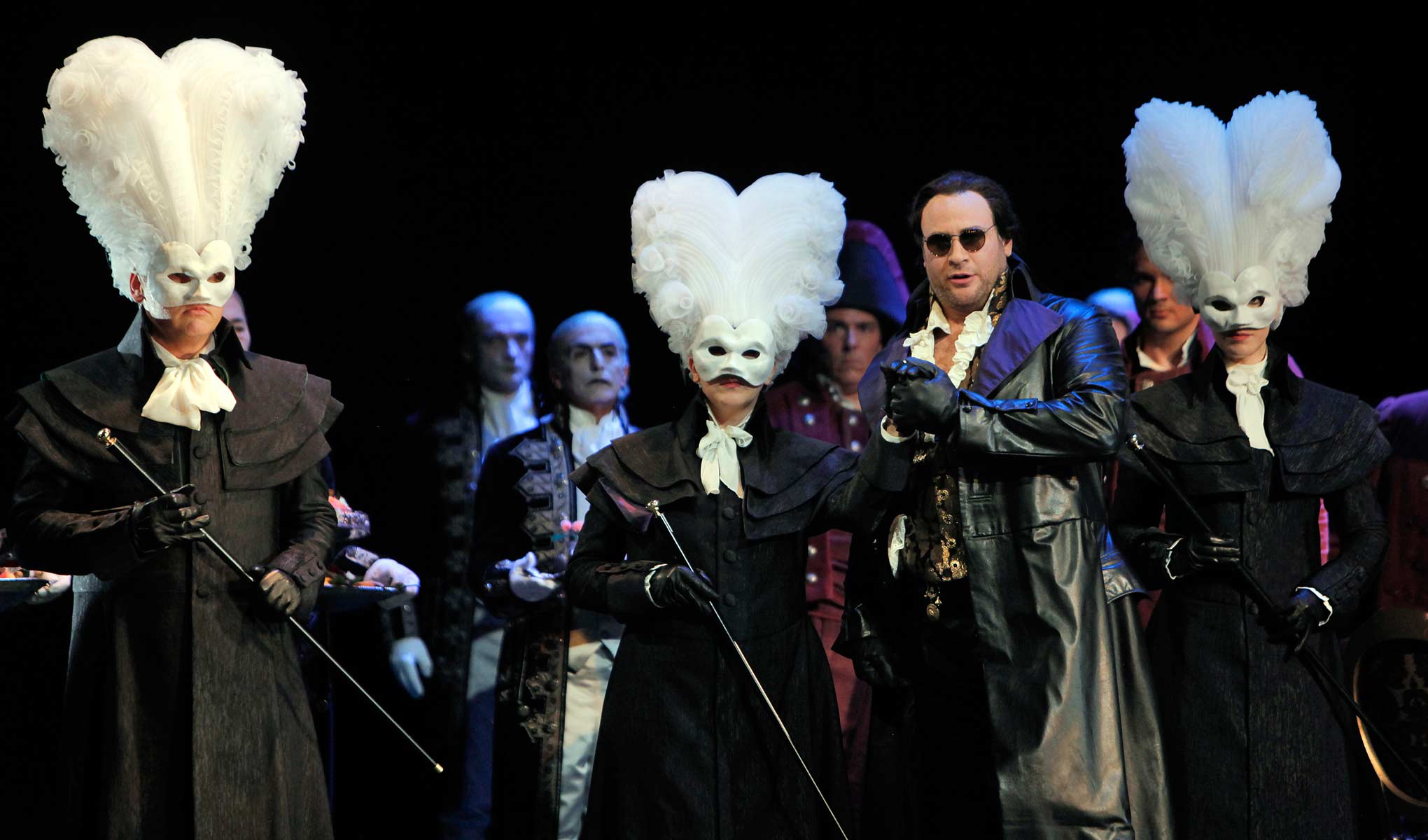
What is our fascination with the person of Giovanni?
It’s like the fascination we have staring at a tempest or tornado— ultimately, an abyss. Staring at Don Giovanni is like Nietzsche’s “if you gaze long into an abyss, the abyss also gazes into you.” This is the fascination of mystery, evil, perdition, and that element of self-destruction that each one of us has inside. Don Giovanni is the mirror of society, a mirror that shows defects, that shows dark secrets, that shows the characters onstage as they really are, and shows the deepest and darkest side of each one of us. He challenges us to resist, yet his seduction power is endless, so it’s up to us to follow him into hell or try to survive by accepting our weaknesses and flaws. He is an example of a man who doesn’t take responsibility for anything he does while breaking the laws that hold society together.
Is Don Giovanni evil?
He’s pure instinct, which is why the 19th century loved this work so much. He’s the negation of all the 18th-century values: reason, logic, enlightenment. Don Giovanni doesn’t have his own musical language, but like a chameleon he hides inside the other characters’ music. He talks all the time, but we never have any introspection. He’s constantly on the move because he’s curious and has a deep craving for life, lust, and women. He cannot stop.
What are the most difficult aspects of presenting this story?
The birth of the opera is quite complex. It was adapted by Lorenzo Da Ponte from a pre-existing libretto in one act by Giovanni Bertati, which had been set to music by Giuseppe Gazzaniga, and was written in a hurry for Prague as a “sequel” to The Marriage of Figaro. As a result, the opera has many flaws, especially the second act. The hardest thing is finding a narrative line that is compact and clean, so the story can flow freely.
What is the most challenging musical moment?
Don Giovanni is never easy! I have directed it twice before, once in Salzburg and recently in Oslo. Technically, the Act I finale is probably the most challenging. There is no easy moment, but all are phenomenal!
How do people like Don Giovanni get away with sexual violence towards women and are even perceived as charming or normal?
Don Giovanni gets away with everything, because he’s incredibly wealthy and, in the original Spanish play, the son of a very powerful man in spain. I guess not much has changed in three centuries.
Who is your favorite character in the opera?
I love all of them, as I feel I have a bit of each one of them in me. I think this is true for everyone who confronts this opera. The beauty of this piece is that we like each one of the characters, depending on the moment. We love Leporello singing the Catalogue Aria until in the following recitative we realize how much pain has been inflicted on Donna Elvira, and so on.
How does the music emphasize or soften the horrors of the events?
The music has enormous force in this opera. It’s strong and shocking at times, with moments of incredible beauty contrasting with moments of horror, all in the midst of a comedy. It’s music that makes us laugh, cry, smile, panic, fall in love. It’s an extraordinary musical universe! The opera does to us what Giovanni does to everyone in the story: it makes us question everything we know, makes us doubt our beliefs to the point that we are not sure if what we see at the beginning is a rape attempt. But I love the ambiguities that this opera presents. It’s always best to leave a theater performance with more questions than answers.