

Backstage with Matthew: Winter Work at the Scene Shop
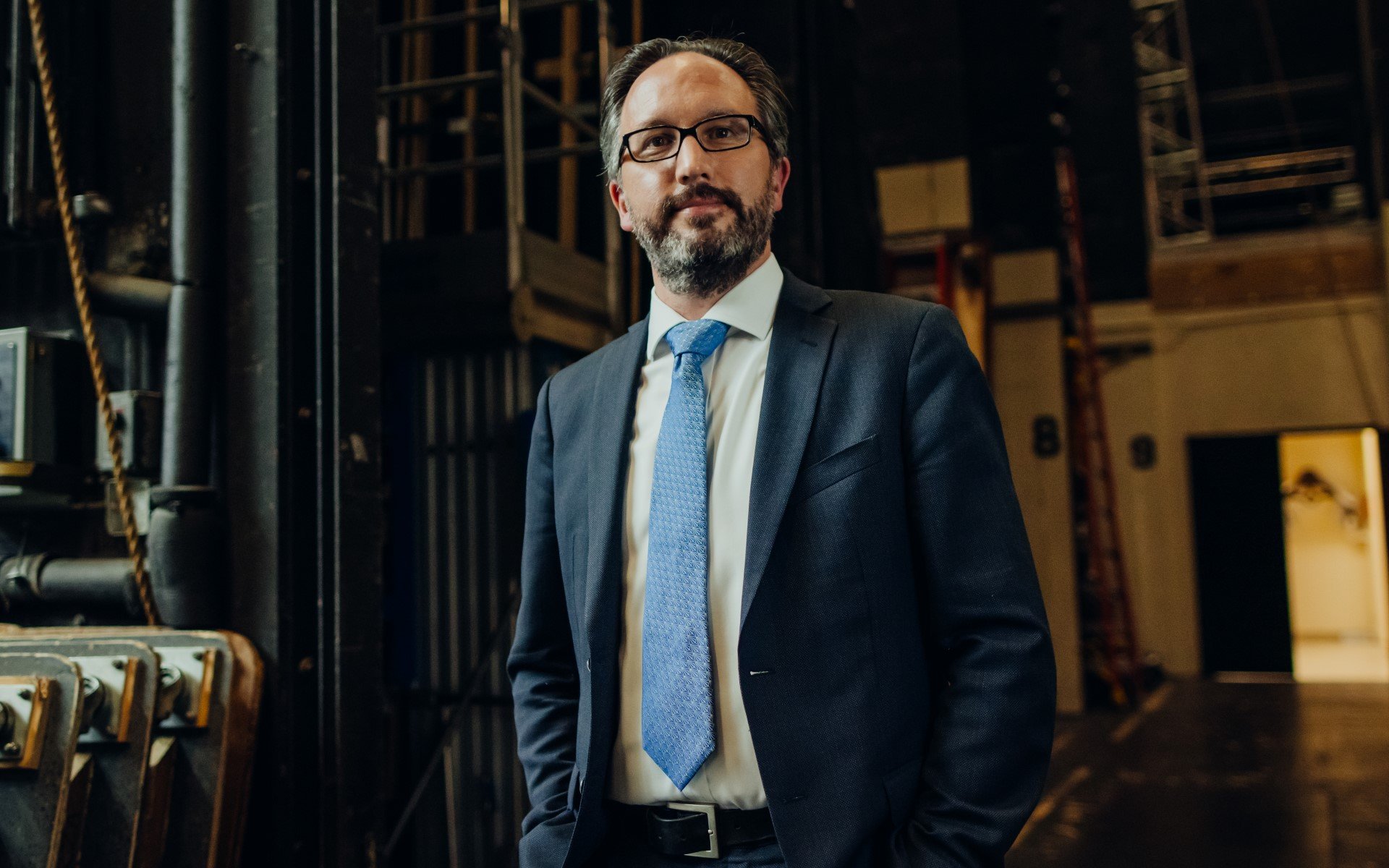
Although these are both existing productions, there is still scenic work that needs to happen, and so I took a trip down to our Scene Shop in Burlingame to see the modifications being made to the Elektra set, and a number of other key projects we’re working on. The Opera’s Scene Shop is one of the jewels in the crown of the Bay Area fabrication and maker community. In addition to building opera sets, we’ve also done work for Bay Area museums, major tech companies, trade shows and other clients, and if you know of organizations who could be interested in hiring the Scene Shop, please never hesitate to reach out to me at matthew@sfopera.com. Many cities and companies have been forced to close their scene shops over the years, and I am passionate about keeping the skills and crafts of ours very much a part of the Bay Area. This is a critical part of what makes a great opera company, and I’m eager to keep work flowing!
The Scene Shop in Burlingame readying for the summer season.
Before getting to the Elektra set, I ran into a few familiar faces, particularly appropriate for this Lunar New Year of the Flame Horse!
Yes, these are the horses from The Monkey King, and they’ve taken up temporary residence in the San Francisco Opera stables! When we closed out the fall season at the end of November, it was a quick move out of the Opera House. We transported the props from the Opera House down to Burlingame on rolling carts for temporary storage in the Scene Shop. But, while everything is already exquisitely wrapped, ordered and catalogued, it needs to be moved into deeper storage and readied for rental opportunities.
Monkey King props in temporary storage at our Scene Shop.
We often use wooden crates to store props, but on this occasion, we need something bigger given the idiosyncrasies of the props and costume pieces in Monkey King. Think of those large fish heads, or the jellyfish, or for the fingers from the end of the production. Those fingers alone are 24 ft tall! As such we’ll be using “COWs” for Monkey King storage. COW stands for “Cage on Wheels” and these are larger units made of metal mesh and designed such that two can fit side by side in a shipping container. The wheels are off-set in such a way that the COW can sit on a liftgate of a truck and not fall over. Our Scene Shop Foreperson John Del Bono told me that was an old rock-and-roll trick!
The bottom right photo shows the mesh material being prepared for the COW, and other photos show the variety of elements that will need to be stored for The Monkey King. The long fingers (bottom left) will still be too long to fit into the COW, so they will be attached onto the roof of the COW, leaving the COW still able to maneuver in and out of shipping containers.
As we prepare Monkey King for storage, it is also an opportunity to make refinements to how the production will be performed in the future.
You can see in the photo below John Del Bono with one of the yellow prop trolleys used in The Monkey King. This was used to hold the snake backstage but was a temporary solution. On the right is an example of a new purpose-built crate we’re building, with its own built-in castors and designed to be resilient to both storage and performing. Taking time for these kinds of refinements is critical to the long-term health of a production and future viability here and elsewhere.
As John so perfectly put it: “We need to make a show warehouseable, transportable, and rentable”
After bidding adieu to the horses, I came to Elektra. As a reminder if you saw it in 2017, and as an introduction to the production for those seeing it for the first time, this production is set in an art museum, hosting an exhibit on the Elektra Myth. The premise of the production is “A Night at the Museum” in which a visitor gets locked in after hours and starts going deep into the exhibit. Gradually her own life melds with the exhibit and she starts embodying the myth and becomes Elektra. The production was hailed by Joshua Kosman in the San Francisco Chronicle as “stunning.” Here’s a photo of the set.
San Francisco Opera’s production of Elektra, designed by Boris Kudlička. Photo Cory Weaver.
There are a number of things we’re doing to ready Elektra for the stage.
The key need was to bring the whole set downstage (or towards the audience) by about 5 ft. This will drastically help with some sight-line issues that were present in the balcony back in 2017 when we first did this production. By bringing the whole set downstage by 5 ft, we can improve sightlines to the second level of the set (where the two trainbearers are standing in the photo above.
Sadly one can’t just move the whole set 5ft downstage: that gets problematic with elements that are hanging in the fly tower including unmovable lighting bridges. So a more creative solution was needed. Enter Erik Walstad, our Technical and Safety Director. Erik has been working with set designer Boris Kudlička (who now runs the Polish National Opera in Warsaw) and director Keith Warner, and they have come up with a twofold creative solution.
- Take 2ft off the downstage edge of the set panels, and bring the set down two feet. That still works given what is in the fly tower. And, handily, there were 2-ft wide pieces that could be easily removed.
- Adjust the main stair unit to make it 3ft less deep on the stage, and bring the rest of the set downstage by 3ft.
How to make stairs less deep, you may well ask! Well, it’s all about how many steps and where they are heading. In the photo above, you see a series of 13 steps coming down, before a landing and then 4 more steps coming towards the center of the stage. Erik figured out how to have only 10 steps coming down, a taller landing, and then 7 steps across. This means that the stair unit doesn’t have to be as deep, allowing us to move the whole set down closer to the audience. The trade-off is that the stairs go further into the stage playing area, but in discussions with Keith and Boris, we’ve determined this is an acceptable trade-off.
So, a new stair flow and improved sightlines for the audience!
Technical and Safety Director Erik Walstad with the top of the original stairs, and then the new stair unit built out of wood (yet to be painted).
There are also a number of knock-on adjustments that had to be made. Going back to the production photo above, you see a glass display case or vitrine just upstage of the cross-stairs. With those stairs now starting higher, the vitrine would get cut off, and so Erik designed a taller vitrine case that you can see above with a laptop on it, perfectly aligned to the lines of the stairs to ensure it will look like a proper museum. (By the way, designer Boris Kudlička has not only designed an operatic museum set; he is also an architect and has designed real-life museums!).
This new set of stairs includes a few hidden elements. One is a little strip of wood on the edge of each stair that you can see in the top-right photo below. It pushes the stair out a touch, and this is to accommodate the ultimate effect of a stone slab finish that will jut out just beyond the edge of the stair (you can almost see that just above Erik’s head in the left-hand photo). It’s an easy addition, and one that adds that extra level of verisimilitude in the set design.
The other hidden element is the crawl space beneath the stairs. In engineering this, Erik created a pathway for someone to crawl under the stair structure to lock the units together and potentially even access parts of the set (e.g. for the stage magic that happens when Klytemnestra meets her untimely end). Erik created all of the internal infrastructure digitally, and then Dylan Maxson in our Scene Shop built it using the CNC router (computer-aided saw). You can see the precision of the work in the bottom right photo below.
Erik Walstad with digital renderings for the adjustments to the Elektra set.
So Elektra will be in excellent shape for the summer! Here are a few of the technical representations of the modified set before we head off to another part of the Scene Shop.
Technical drawings showing the original stairs (left) and then the new stair construction (right), including run-off stairs that take performers offstage.
A 3D rendering of the new stairs, created by Erik Walstad, also showing the new vitrine position.
The modeling is so advanced now that you can see the reflections of the organ bays in the glass of the vitrine if you look closely.
Leaving the Elektra area, my attention was grabbed by a sea of sparks, so we headed over to the metalwork area of the Scene Shop to see what Dennis Forry was working on. (Dennis brings incredible experience to the Shop, having welded 4” thick nuclear submarines and paper-thin alloys for the aerospace industry!)
Dennis Forry Working on the Belly Box.
This is a very interesting project – an enhancement to our traveling Bohème Out of the Box. This is our converted shipping container version of La Bohème that we take to cities and tech campuses around the Bay. The set folds out from a 20 ft shipping container. We’ll be announcing this spring’s destinations very soon.
Photo: Stefan Cohen
In the first year of the Box, we used generators to power the lights and sound equipment. But when we moved the Box to only be in the daytime, we didn’t need as extensive a lighting package and were able to forego the expensive generators, and instead powering the whole enterprise using a set of nine large batteries. But, while much more efficient, the batteries are heavy and cumbersome and need to be charged between each location.
This year we are building a “Belly Box” – a metal container that will sit underneath the chassis of the shipping container and house the nine batteries. This is being built in-house at the Scene Shop as it needs to be extremely durable, able to protect the batteries and withstand debris flying up from the road. It also needs to be fully accessible so that the batteries can remain inside the unit while being charged, hence the opening you can see in the bottom right photo. Four of the nine batteries are in the top left photo, and John Del Bono is showing the custom casements for the batteries. Once finished, the whole unit will be turned upside down and welded onto the base of the chassis as a permanent addition. Bohème Out of the Box will be even more flexible and nimble when it takes to the road in just a couple of months.
Even without a new set to build this year, there is critical work that still happens at the Scene Shop, readying the physical elements of the production for the stage, and ensuring that the new productions we have built can be properly stored and transported.
The ingenuity and resourcefulness of the Shop is extraordinary. Being there is always a revelation. You realize that this team can build anything in this space. It’s a place of infinite creativity and great pride, and I feel deeply blessed that we are one of the few companies in America still with this kind of capability.
I look forward to sharing all this with you very soon, whether out on the road with the Box or in the extraordinary psychological powerhouse that is Elektra on stage this June!