

Daniela Mack on finding inspiration in family
SAN FRANCISCO OPERA: As a teen, you went from doing piano lessons to singing — and you got voice lessons at age 15 from a teacher at Rice University. What was the most difficult part of making singing your career?
DANIELA MACK: I think what was most difficult then is still the most difficult part today. The calling to be a performer is such a gift and a privilege. Making a path as an artist is invigorating and can be rewarding almost on a spiritual level. But the flip side is that it comes with a guarantee of being judged, rejected and discouraged. Developing a way to tune out the negative energy has taken time and is still a work in progress. So much of this career is out of our control, and rolling with the punches is essential!
SAN FRANCISCO OPERA: You met your future husband, tenor Alek Shrader, at the Merola Opera Program, before you both went on to be San Francisco Opera Adler Fellows. What was your first impression of him?
MACK: I met Alek at a sushi restaurant in San Francisco the day before our Merola summer started. Before I knew anything about him as a performer, I was instantly drawn to his cool and down-to-earth attitude. He was unlike most singers I knew in that he didn’t seem concerned with playing the game of the business. He was simply himself and quietly as charming as could be. And he was funny! I was smitten very early on. It also didn’t hurt that I thought he was the most handsome guy I’d ever met!
SAN FRANCISCO OPERA: There’s a lot of stigma around on-stage, off-stage romance, especially when you’re starting out as a young artist, as you were at Merola. How did you navigate that?
MACK: I remember being pointedly told that dating a singer was a bad idea, that inevitably one of our careers would thrive and the other would suffer, and that bitterness would ensue. I think that can be true for some couples, but neither one of us has ever felt a detrimental competition with the other, and our priority has always been our connection. When you find your person, what they do for a living isn’t a concern. In our case, having someone who understands what the other is going through implicitly has been a tremendous gift through the years.
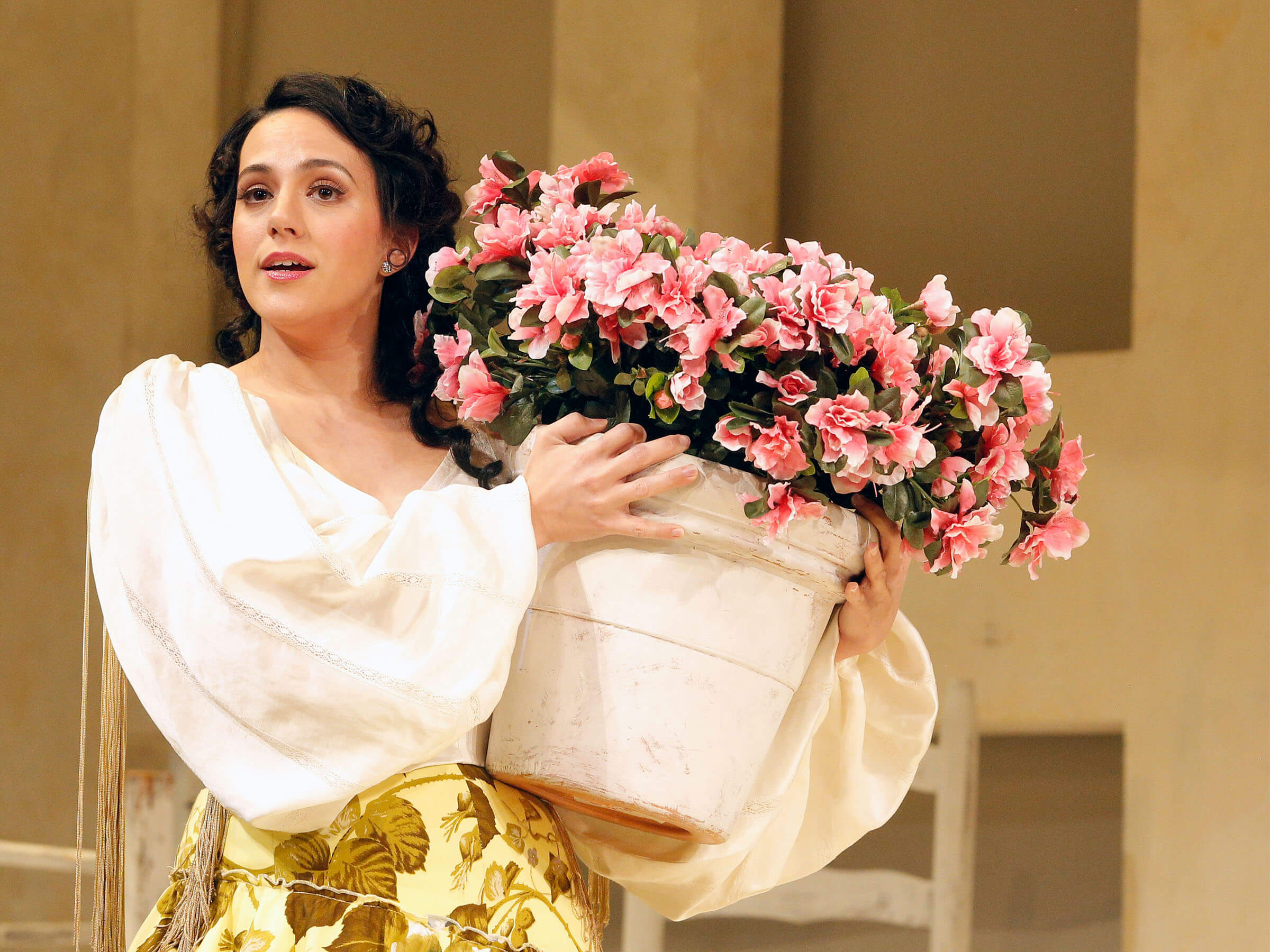
SAN FRANCISCO OPERA: You’re also starring in the role of Rosina in the comedy The Barber of Seville for our 2020–21 season. How many times have you performed Rosina around the world, and how do you keep things fresh?
MACK: Rosina is one of my favorite roles to perform, and I know her well! I have sung in eight productions and somewhere around 50 performances. (To my shame, I haven’t counted!)
Every time I’m part of a new take on the piece, her character development changes a bit. The devil is in the details, and even if I’m in a fairly traditional telling of the story, I love to add little eccentricities to her character and her physicality. Giving her a new habit keeps her human and interesting for me.
Also, the cast changes constantly. No two stage partners will deliver their lines in the exact same way. The comfort and familiarity I have with this role affords me the chance to live in the moment, and to be much more authentically reactive.
SAN FRANCISCO OPERA: You’ve told other publications that you modeled your Rosina after your grandmother — which might strike some as a surprising choice. How did you arrive at that decision? And how did your family react to your portrayal?
MACK: Yes! That pertains specifically to this production at San Francisco Opera. When [The Barber of Seville director] Emilio Sagi first created it in 2013, I came into the process viewing her through a fairly modern lens.
I remember him modeling this very specific set of coquettish mannerisms and glances, and my mind went immediately to my grandmother. She was a tiny, youthful spitfire of an Argentine woman, whose mother was from Santiago de Compostela in Galicia. She was so theatrical in her demeanor, and everything was larger than life and loaded with intention. If she had been allowed to be on stage as a young girl, she would have been perfectly at home in the limelight. If she were alive, I think she would be proud to be channeled for this feisty and charming Rosina!
SAN FRANCISCO OPERA: What would be your dream role — real or imagined? What story would you most like to tell on stage?
MACK: I have such a long bucket list of roles that fall all over the map, it’s hard to choose just one! My high-school self would be ecstatic to sing Dolly Levi in Hello Dolly. My present self would love to sink my teeth into Berlioz’s Dido in Trojans.
I also just love the prospect of new and contemporary music being written for, by and about complex women. There are so many interesting subjects throughout history whose stories I would love to tell!